

You can build in a buffer zone to protect against exercise and monitor the position every day to ensure that no surprises occur. But is this safe?
The market risk cannot be ignored, but to some extent, it can be controlled. For example, in a high-priced stock like amazon.com, a wide range of strikes set up a flexible method for using uncovered calls. As of the close of May 17, 2019, AMZN closed at $1,869 per share and had fallen 38.57 points since the previous day. Given this point range, how safe (or risky) would it be to open an uncovered calls with a 50-point buffer zone? Focusing on the strikes of 1,920 (50 points above the closing price), can a “reasonable” risk level be established?
As a first point to be made, the collateral requirement for an uncovered 1,920 strike is 20% of strike value, or $38,400 (minus the premium received for selling the call). This high collateral level should be kept in mind when evaluating the rationale for an uncovered call.
Looking at the AMZN chart for the May 17 close, it appears that price has been in a gradually increasing channel of about 225 points. This is a broad range, but given the price level of $1,869 per share, this trading range does not seem extreme. But for the uncovered call, are there opportunities here? The chart reveals the typical trading range as well as the potential range of price movement in single sessions.
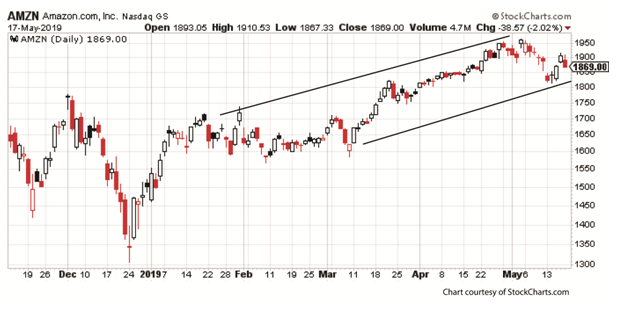
What you see here is what at first glance is a low level of volatility in the last three to four months. Based just on this, would it make sense to open a short-term uncovered call?
Looking at the one-week and two-week calls with a 50-point buffer, we find:
- 7-day 1,920 call, bid 6.00
- 14-day 1,920 call, bid 12.60
Adjusting the 50 point buffer for the premium, the true buffer is 57 points for the 7-day call (1,920 – 1,869 + 6) or 63.60 points for the 14-day option (1,920 – 1,869 + 12.60).
The rationale for the uncovered call is: With protection of either 57 points or 63.60 points, we may expect time decay to move rapidly. Profits will accumulate as a result, and if the underlying price moves against the position, the buffer zone allows us to buy to close the position without the uncovered call moving in the money.
This is a neat and tidy idea, and it is appealing to the logic a trader would enjoy in this situation. The buffer zone protects the position from exercise, and time decay ensures that the call is unlikely to move suddenly in the money.
But is this a logical assumption?
Between December and February on the chart, the daily breadth of trading for AMAN was greater than 50 points on about 10 sessions. Although volatility more recently has been lower, there have been incidents on 50-points or more moves in a single day. This occurred most recently on May 13, for example.
This means that even with the buffer zone and favorable rate of time decay, the strategy can go south in a hurry. You have t ask yourself whether the exposure is worth the risk. For premium of only $600 (7-day) or $1,260 (14-day), are you willing to hold an open short call that could be exercised if the underlying price moved rapidly in a single day?
The exposure could be suitable for some traders, but not for most. An alternative would be to open uncovered puts. These are lower-risk even though the market risk is the same as that of a covered call. Unlike the uncovered call with unlimited upside risks, the uncovered put has limited possible risks on the downside and can be rolled forward to avoid exercise. But just as the price of AMZN can move up 50 points or move, it can just as easily and unexpectedly move down.
The 50-point buffer is slightly more favorable for uncovered puts than for uncovered calls. The following premium values were found:
- 7-day 1,820 put, bid 8.45
- 14-day 1,820 put, bid 15.30
Adjusting the 50 point buffer for the premium, the true buffer is 57.45 points for the 7-day put (1,869 – 1,820 + 8.45) or 64.30 points for the 14-day option (1,869 – 1,820 + 15.30).
The same analysis of risk must be applied to make a sound judgment about the risk in this position. Both the uncovered call and the uncovered put look reasonable given rapid time decay, buffer zone, and short term remaining until expiration. But the possibility of a 50-point move (or more) in one day adds risk to the strategy in both cases.
Some smart guidelines for writing uncovered options:
-
For calls, avoid having an open position in the ex-dividend week. Although Amazon is used in the example and it does not pay a quarterly dividend, any stock that does offer dividends is most vulnerable to early exercise during this week. A trader holding a long call could exercise it if it moves in the money, and then sell shares on or after -ex-date to get a quarterly dividend in a one or two day holding period – the dividend capture strategy.
-
For both calls and puts, avoid having open position sin the week of earnings announcements. An earnings surprise could lead to rapid movement to ITM status and an immediate early exercise, which could be disastrous to the short position.
- Be aware of the risks. Nothing is foolproof, and even with short expiration, buffer zone, and rapid time decay, what looks good on paper can turn into a big money loser. No one likes surprises, and the worst surprise of all is a big loss from a poorly-placed short option trade.
Michael C. Thomsett is a widely published author with over 80 business and investing books, including the best-selling Getting Started in Options, coming out in its 10th edition later this year. He also wrote the recently released The Mathematics of Options. Thomsett is a frequent speaker at trade shows and blogs on his website at Thomsett Guide as well as on Seeking Alpha, LinkedIn, Twitter and Facebook.
Related articles:
- Uncovering The Covered Call
- Selling Naked Put Options
- The Naked Put, A Low-Risk Strategy
- 2 Tweaks To Covered Calls And Naked Calls
- Dangers Of The Covered Call
- Naked Options: Redefining High Risk
- Are Uncovered Calls Always High-Risk?





There are no comments to display.
Join the conversation
You can post now and register later. If you have an account, sign in now to post with your account.
Note: Your post will require moderator approval before it will be visible.