

SteadyOptions is an options trading forum where you can find solutions from top options traders. Join Us!

We’ve all been there… researching options strategies and unable to find the answers we’re looking for. SteadyOptions has your solution.

Using ORATS Wheel To Test Entries and Exits


My favorite option strategy backtester is ORATS Wheel, which includes a free trial for those interested. In the Steady Momentum PutWrite Strategy (SMPW), we sell out of the money puts on global equity indexes and ETF’s while holding our collateral in short and intermediate term fixed income ETF’s.

There are many potential ways to manage a short put trade, so in this article I’ll share some backtested research to look at the differences between a few methodologies.


In SMPW, we benchmark our performance against an ETF that attempts to replicate a popular index, CBOE S&P 500 PutWrite Index (PUT). PUT uses a simple approach of selling front month S&P 500 puts and holding them until expiration. 33 years of historical data is available on CBOE’s website to see the results of this straightforward approach. I like to think of PUT as a broad measure of the “beta” of put writing, similar to an index like the Russell 2000 for US Small Cap stocks.


We’ll test this methodology on 7 different underlying assets from 2007-2019 (the data period available in ORATS Wheel). We’ll also test entering at 45 days until expiration (DTE) with an exit at 21 DTE. Lastly, we’ll test a 30 DTE entry with exits occurring when 75% of the credit received has been earned or 5 DTE, whichever occurs first. We’ll look at both excess annualized returns, net of estimated transaction costs, as well as risk adjusted returns with the Sharpe Ratio. Sharpe Ratio is a popular risk adjusted return measurement that is calculated as annualized excess return divided by annualized volatility.


Results
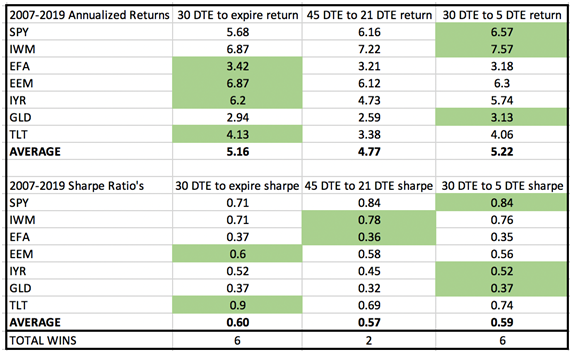
image.png


Interpreting The Data

There are many ways to interpret what this data is telling us. I prefer to increase the sample size when reviewing parameter choices by averaging results across multiple underlying assets. In this case, 7 symbols were tested over a period of 13 years, with entries assumed to occur every 7 days, creating a sample size of more than 4,500 total trades.  A large sample size helps minimize the impact of any outlier trades that may have occurred during the sample period that might otherwise skew results in a way that could lead to false conclusions.


Overall, it doesn’t look like there was a significant difference in results based on the trade parameters over this time period. This is good, as we prefer to see broad parameter stability. The 45 DTE to 21 DTE method produced average results that were slightly worse than the other 2 methods, which is interesting considering this approach is recommended by a popular options trading educator and brokerage firm.


In SMPW, we enter our short puts around 30 DTE and look to exit when we’ve made 75% or more of the credit received or about 5 DTE, whichever occurs first. With lower priced ETF’s that represent International equities we typically wait to exit winning trades until they are worth a nickel or less, as certain brokers allow you to exit these positions commission free. The logic, which is generally supported by the data in the chart, is that rolling winning trades ahead of expiration when we’ve made most of the potential profit maymodestly increase returns over the long term since we expect the equity premium to persist. Exiting losing trades a few days before expiration slightly reduces the risk of large losses due to the negative gamma of a short option that increases as expiration approaches.  


Conclusion: The Power of Diversification

My final point is meant to highlight the power of diversification.  Looking specifically at the 30 DTE to 5 DTE results, we see an average Sharpe Ratio of 0.59.  I had the ORATS Wheel combine together all 7 symbols into an equal weighted portfolio, and the result was a Sharpe Ratio of 0.76...a 29% relative increase.  Diversification is a generally accepted way to either A. increase returns for the same risk or B. maintain the same return with lower risk. Diversification can be achieved in many ways, and it’s one of the most compelling opportunities for “craftsmanship alpha” in the portfolio construction process that is used in our SMPW strategy.


Jesse Blom is a licensed investment advisor and Vice President of Lorintine Capital, LP. He provides investment advice to clients all over the United States and around the world. Jesse has been in financial services since 2008 and is a CERTIFIED FINANCIAL PLANNER™ professional. Working with a CFP® professional represents the highest standard of financial planning advice. Jesse has a Bachelor of Science in Finance from Oral Roberts University. Jesse manages the Steady Momentum service, and regularly incorporates options into client portfolios.


Related articles:

What Is SteadyOptions?

12 Years CAGR of 114.5%

Full Trading Plan

Complete Portfolio Approach

Real-time trade sharing: entry, exit, and adjustments

Diversified Options Strategies

Exclusive Community Forum

Steady And Consistent Gains

High Quality Education

Risk Management, Portfolio Size

Performance based on real fills

Subscribe to SteadyOptions now and experience the full power of options trading!
Subscribe

Non-directional Options Strategies

10-15 trade Ideas Per Month

Targets 5-7% Monthly Net Return

Visit our Education Center

Recent Articles

Articles

  • Delta-Neutral Options Strategies for Earnings

    Most options trading starts with a directional guess: you think a stock goes up, so you buy calls. But some of the most reliable earnings strategies don't require you to be right about direction at all. They're built to profit from volatility itself — from how much a stock moves, or from the collapse of implied volatility after the report — while staying largely indifferent to which way it goes.

    By krisbee,

    • 0 comments
    • 1798 views
  • The Last 14 Minutes: Why We Stopped Looking at Options Closing Prices

    Here is a puzzle from our own earningsstudy charts. On Thursday, August 6, the ADBE one-week put calendar — the same 260 strike, the same September 11/18 expirations — was worth $1.425 at 3:46pm and $2.60 at the 4:00pm close. Nothing happened to the trade in those fourteen minutes.

    By krisbee,

    • 1 comment
    • 4807 views
  • Expanded Trading Hours for Select Equity Options

    The Cboe Options Exchange will start offering expanded trading hours for select high-liquidity single-stock equity options. The schedule features a morning Global Trading Hours (GTH) session from 7:30 a.m. to 9:25 a.m. ET and an afternoon Curb session from 4:00 p.m. to 4:15 p.m.

    By Kim,

    • 0 comments
    • 1160 views
  • How LEAPS Differ From Short-Term Options

    LEAPS stands for Long-Term Equity Anticipation Security. Which is just a long-dated option, typically referring to those with expirations more than a year out. There’s no technical difference between LEAPS and shorter-term options other than the expiration date. They’re traded on the same exchanges and have the same rules surrounding margin and whatnot.

    By Pat Crawley,

    • 0 comments
    • 31796 views
  • Why Not to Hold Strangles Through Earnings

    In my previous article, I described a strategy of buying a long strangle a few days before earnings and selling them just before earnings. In this article, I will show why it might be not a good idea to keep those strangles through earnings.

    By Kim,

    • 0 comments
    • 6503 views
  • Pre-Earnings Entry Price: What 31,000 Cycles Say

    Every card in the scanner carries a block called How expensive is this entry? It compares what you would pay today against what the same setup cost on the same ticker at the same point in past cycles. I built that block in August. It reads well. But a reading that looks sensible and a reading that predicts something are different things, and until last week I had only the first.


    By Romuald,

    • 3 comments
    • 1330 views
  • Expensive Compared to What?

    A trader looks at a pre-earnings straddle and asks whether it is expensive. It is the right instinct and the wrong question, because the word carries no meaning on its own. Expensive against what? A $12 straddle on a $200 stock is not expensive or cheap. It is $12.

    By Romuald,

    • 0 comments
    • 999 views
  • Beyond Strategies: What Options Traders Should Know

    Options education almost always begins with structures. Traders learn vertical spreads, calendars, butterflies, condors, covered calls and straddles, study the expiration diagrams, work out maximum profit and loss, and build a sense of the conditions each structure is supposed to suit. That foundation is necessary and there is no way around it.

    By Kim,

    • 0 comments
    • 1728 views
  • SPX vs SPY Options: Which One Should You Trade? (2026 Guide)

    Both SPX and SPY options give you exposure to the S&P 500. They track the same 500 stocks, move nearly tick-for-tick, and offer the same core strategies — credit spreads, iron condors, butterflies, and 0DTE trades. Yet the two products settle differently, are taxed differently, and carry very different assignment risks.

    By krisbee,

    • 0 comments
    • 6118 views
  • Strike Price Effects Or Pinning Revisted

    Loyal readers of this blog will recall my post from 2019 “Pinning Down the ‘Option Pinning’”. If you have not heard of pinning have a look at that article as – spoiler – everything in it as well as Jeff Augen’s observations in his books which are referenced is still valid.

    By TrustyJules,

    • 0 comments
    • 2878 views

  Report Article


We want to hear from you!


There are no comments to display.


Join the conversation

You can post now and register later. If you have an account, sign in now to post with your account.
Note: Your post will require moderator approval before it will be visible.

Guest
Add a comment...

×   Pasted as rich text.   Paste as plain text instead

  Only 75 emoji are allowed.

×   Your link has been automatically embedded.   Display as a link instead

×   Your previous content has been restored.   Clear editor

×   You cannot paste images directly. Upload or insert images from URL.

Loading...