

SteadyOptions is an options trading forum where you can find solutions from top options traders. Join Us!

We’ve all been there… researching options strategies and unable to find the answers we’re looking for. SteadyOptions has your solution.

Debunking the "Trading Options for Income" Myth


"Real trading system returns are too irregular in the short term for consistent weekly returns every time and the only 'trader' that every had regular monthly returns was Bernie Madoff" - Steve Burns. So true. This is why "trading options for income" promoted by some options "gurus" is so misleading.

Search for "Trading Options for Income", and you will get a bunch of results:

  • Learn how to generate consistent stream of income trading options and earn high profits.
  • How to Earn Consistent Income Trading Weekly Options.
  • Make Money Selling Naked Puts - How I Make An Extra $3k - $5k Per Month In The Stock Market.
  • How to Sell Naked Puts for Big Income.

And many more.

So how does it work?

You would implement an options trading strategy where you can get a credit, and your account would be credited with the money you got. Some of those strategies include:

Example

You decided to follow an advice from an options guru who aims to provide you with consistent income of 5% per week. That would translate to 260% per year, not compounded. They would recommend entering weekly credit spreads, getting a credit and allowing them to expire worthless, so you keep the credit.

Lets say you follow their advice and enter 2435/2440 call credit spread on June 1, 2017. You get $0.30 credit, and the short calls have delta of 11 which gives the trade 89% probability of success. This is how the P/L chart looked like:
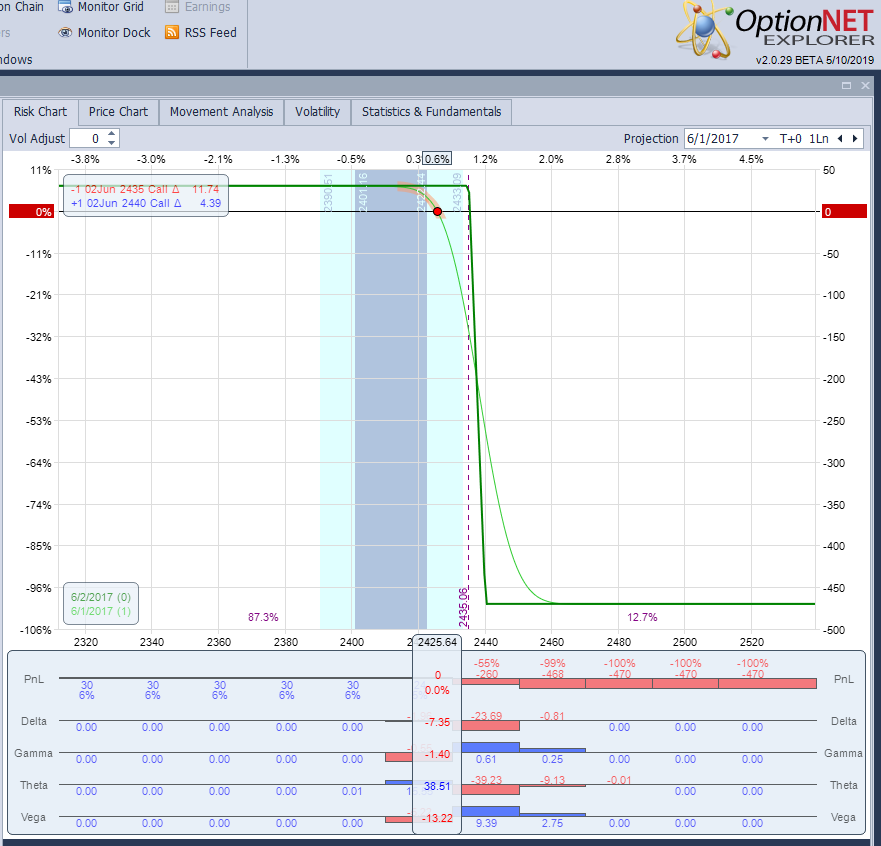
image.png

All you need is for SPX to stay below your 2435 short strike for one day - and you keep the whole credit. ~90% of the time, you will achieve that goal.

The next day, something "unexpected" happens. SPX rises to 2440, and the trade is losing 80%.
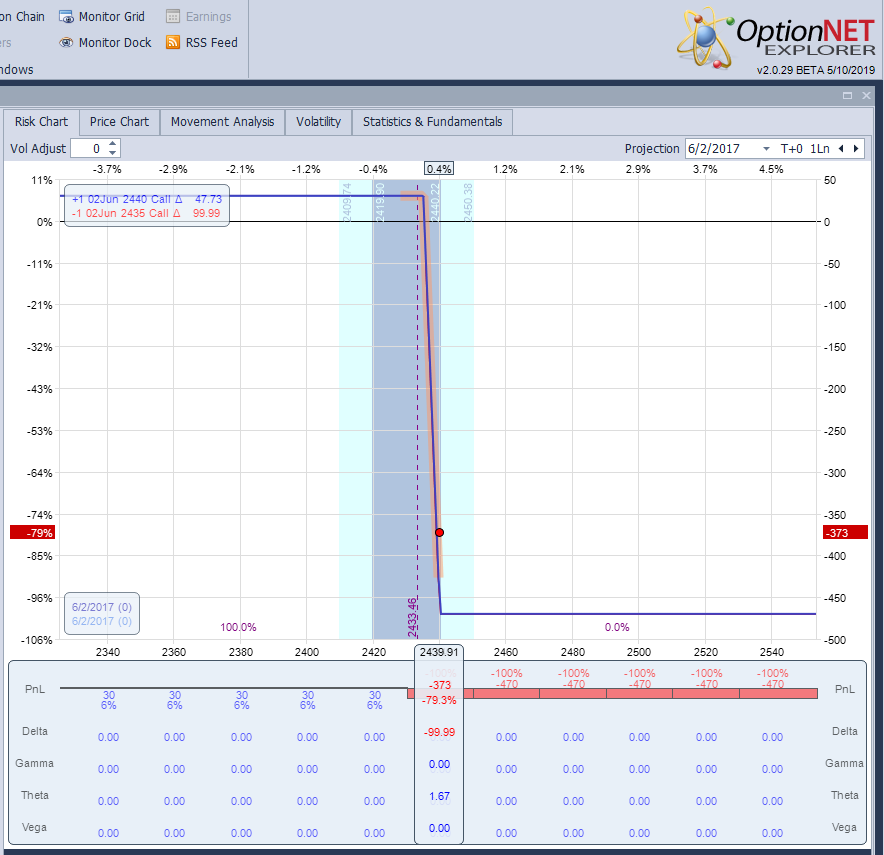
image.png


Now you need to buy back the credit spread for the full $5.00, resulting a $470 loss. Congratulations! You just gave back a year worth of previous months "income".

The track record of this "guru" looks something like this:
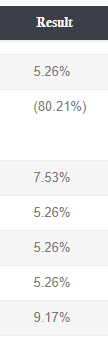
image.png

You might say that this example is a bit extreme, but it was a real trade recommended by a real subscription service. Of course you can select a different expiration or strikes, but the principle remains the same. The fact that your trade resulted a credit doesn't mean that the money will stay in your account. This is NOT an income. If the trade goes against you, you will need to close it for a debit which might be higher than the credit you got. Sometimes MUCH HIGHER. In some cases, one bad month can eat the "income" of a whole year.

Conclusion

As our contributor Mark Wolfinger mentions: "If you trade the options “income” strategies (iron condor, credit spread, naked put, covered call, etc), the credit collected has NOTHING to do with how much loss you should be willing to accept."
 

But isn't it just semantics? Well, the biggest risk of "trading options for income" is if that income is needed or expected to be used as current income. That is, if it's needed to cover your current expenses. If you start depending on income from "income generating strategies", you must recognize that there will be months that you lose. Not only do losing months eliminate that month's income, many times the losses will be equivalent to having to "pay back" income from previous months.

There's just no way that the Market is so predictable that you can target and achieve a predefined amount of income month in and month out.

Options trading is NOT an income producing strategy. If you want a consistent stream of income, buy dividend stocks, rental properties, bonds etc. When you are trading options (or any other instrument), there will be losing weeks, losing months and sometimes even losing years, no matter how good you are. If you see someone promising you a consistent stream of income from trading or investing, they are probably doing something similar to Bernie Madoff.

Does it mean you should not be selling options for credit? Not at all. Options selling strategies should be part of any well diversified portfolio. Just stop treating it as "income" and start treating it as regular trading, that will have its ups and downs.

Related articles


What Is SteadyOptions?

12 Years CAGR of 114.5%

Full Trading Plan

Complete Portfolio Approach

Real-time trade sharing: entry, exit, and adjustments

Diversified Options Strategies

Exclusive Community Forum

Steady And Consistent Gains

High Quality Education

Risk Management, Portfolio Size

Performance based on real fills

Subscribe to SteadyOptions now and experience the full power of options trading!
Subscribe

Non-directional Options Strategies

10-15 trade Ideas Per Month

Targets 5-7% Monthly Net Return

Visit our Education Center

Recent Articles

Articles

  • Options Trading Risk Management: Position Sizing, Drawdowns, Diversification

    What do you think matters most in financial markets? Even with years of experience, a good strategy, and plenty of capital, you can still lose a lot of money if you don’t manage your risk. Uncertainty is part of what makes financial markets interesting, and every trader or investor has to deal with it.

    By Naoufal Seddik,

    • 0 comments
    • 1091 views
  • Your 30-Delta Put Is Not a 30% Chance

    What four option chains say about delta as odds, and what it means for strangles and the wheel

    A quick question before we start. You sell a 30-delta put on a volatile stock with about a month to expiry. What is the chance that it finishes in the money? Keep your answer in mind.

    By Nikolai Alexander,

    • 0 comments
    • 442 views
  • M: one green row, and what TGT had to do with it

    Yesterday I opened M's Straddle page. M reports Dec 2 before the open, so Dec 1 is the last day to hold. One row of the History Matrix stood out in https://earningsstudy.com/ tool: entering at T-9 was green on every exit, while almost everything around it was red. Across all 78 entry and exit pairs, the typical one returned −2.0%. The T-9 row ran from +1.1% (out the next day) to +22.2% (out at T-3), and +9.5% held to T-0.

    By krisbee,

    • 0 comments
    • 458 views
  • AI In Options Trading: Could It Change The Way You Trade?

    Have you ever imagined handing your trading strategy to an AI system that could analyze markets, backtest your rules, and execute trades for you? Today, with the right data and tools, that’s possible. AI can help you analyze markets, backtest a strategy across years of data, calculate risk, and even optimize your portfolio.

    By Naoufal Seddik,

    • 0 comments
    • 1552 views
  • 5 Stocks For Options Trading In November 2026

    S&P 500 companies lost nearly $3 trillion in market value on November 5. The S&P 500 fell 4.36%, the Nasdaq Composite fell 5.52%, and the Dow lost 3.44%. The Russell 2000 was down more than 4%. Investors were already wondering if all the money tech companies were spending on AI would pay off.


    By Naoufal Seddik,

    • 0 comments
    • 2809 views
  • What the Gamma Map Said Before Nine Bullish Combos

    In mid-September SteadyOptions added a new structure to the model portfolio: the earnings bullish combo, a call debit spread paired with a narrower put debit spread as a hedge, opened ahead of earnings and closed before the report. 

    By krisbee,

    • 0 comments
    • 7283 views
  • Delta-Neutral Options Strategies for Earnings

    Most options trading starts with a directional guess: you think a stock goes up, so you buy calls. But some of the most reliable earnings strategies don't require you to be right about direction at all. They're built to profit from volatility itself — from how much a stock moves, or from the collapse of implied volatility after the report — while staying largely indifferent to which way it goes.

    By krisbee,

    • 0 comments
    • 10837 views
  • The Last 14 Minutes: Why We Stopped Looking at Options Closing Prices

    Here is a puzzle from our own earningsstudy charts. On Thursday, August 6, the ADBE one-week put calendar — the same 260 strike, the same September 11/18 expirations — was worth $1.425 at 3:46pm and $2.60 at the 4:00pm close. Nothing happened to the trade in those fourteen minutes.

    By krisbee,

    • 3 comments
    • 7214 views
  • Expanded Trading Hours for Select Equity Options

    The Cboe Options Exchange will start offering expanded trading hours for select high-liquidity single-stock equity options. The schedule features a morning Global Trading Hours (GTH) session from 7:30 a.m. to 9:25 a.m. ET and an afternoon Curb session from 4:00 p.m. to 4:15 p.m.

    By Kim,

    • 0 comments
    • 2738 views
  • How LEAPS Differ From Short-Term Options

    LEAPS stands for Long-Term Equity Anticipation Security. Which is just a long-dated option, typically referring to those with expirations more than a year out. There’s no technical difference between LEAPS and shorter-term options other than the expiration date. They’re traded on the same exchanges and have the same rules surrounding margin and whatnot.

    By Pat Crawley,

    • 0 comments
    • 33327 views

  Report Article


We want to hear from you!


There are no comments to display.


Join the conversation

You can post now and register later. If you have an account, sign in now to post with your account.
Note: Your post will require moderator approval before it will be visible.

Guest
Add a comment...

×   Pasted as rich text.   Paste as plain text instead

  Only 75 emoji are allowed.

×   Your link has been automatically embedded.   Display as a link instead

×   Your previous content has been restored.   Clear editor

×   You cannot paste images directly. Upload or insert images from URL.

Loading...