

It is an all or nothing idea, which either pays out under predefined circumstances, or expires worthless.
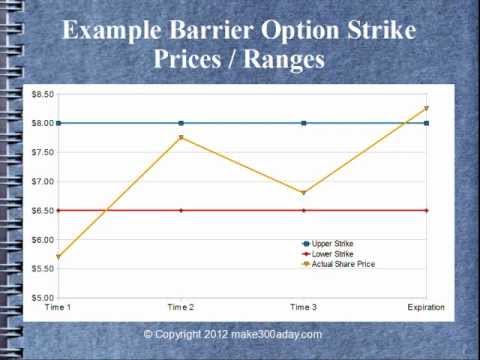
Two triggers are involved, an upper and a lower price of the underlying. If the underlying price touches or passes either of these triggers, the option expires worthless or becomes a valid instrument (depending on whether it is set up as a knock-in or a knock-out contract). To compare, the single barrier defines only an upper or a lower barrier, so underlying movement in the opposite direction does not trigger an event (knock-in or knock-out).
Traders can view the double barrier option in one of two ways. Either it is a complex contract with two elements (upper and lower), or a combination of two barrier options coexisting in the same contract. If it is a knock-in, the speculation is that the underlying price will move in a large enough way to yield a profit, like a long straddle. If a knock-out, the hope is that the underlying price will remain within the price range between the barriers, and this is like a short straddle. The difference is crucial. In a straddle, either side can be closed or rolled. In the double barrier option, the two sides cannot be separated or closed before expiration. Also, the option itself only comes into existence if the price levels are exceeded (knock-in) or expires automatically when those barriers are not exceeded (knock-out).
However, this contract is not truly a combination of two knock-in or knock-out options. If it were, a breach of either barrier would leave the other side in effect. Because it is a single contract, the two barriers are linked and cannot be separated.
Three things drive the pricing and value of a double barrier option. First is duration. The greater the time to expiration, the higher the risk of a breach, so the cheaper the option. Second is moneyness. The closer the price is to the barrier on either side, the more likely a breach, and the cheaper the option. Third is volatility. The greater the volatility, the cheaper the option due to the higher likelihood of a breach.
These three factors operation opposite the vanilla option. Longer time, closer moneyness, and higher volatility normally define higher option pricing, not lower. This opposite attribute makes the barrier option particularly interesting and opens many possibilities. For example, a double barrier could be used as a hedge against vanilla options, since the causes of change in valuation are opposite of vanilla contracts. However, this becomes complex and potentially costly as well. Most traders may find the possible option hedge interesting but impractical.
Another attribute of the double barrier option is that it does not matter what happens after the price barrier has been breached. The expired knock-out cannot be brought back to life even if price retreats, and a knock-in remains in effect no matter how price behaves after reaching one of the barriers. This observation has further ramifications, depending on whether the double barrier is set up based on calls or puts.
The reason for opening any form of barrier option normally is based on a desire to hedge portfolio positions. It is less expensive to hedge with double barriers than with the use of spreads or straddles (or combinations of both). The lower cost makes sense based on the built-in restrictions of the double barrier contract. The greatest disadvantage is the European style expiration. With vanilla options and American style, positions can be closed at any time, either taking small profits or minimizing losses. In this respect, the hedge with vanilla options is more expensive but also more flexible.
The limited risk of double barrier options makes them attractive for hedging, in some cases more so than the use of more expensive and higher-risk vanilla options. The barrier option may present the closest tracking of a trader’s beliefs concerning future underlying price movement. This belief is likely to refer to degree of movement and not solely to direction. The double barrier eliminates risks associated with volatility seen in some products such as foreign currency exchange rates.
Despite the advantages to hedging with double barrier options, clear risks and disadvantages also must be considered, for both buyers and sellers in the hedging universe. The double barrier option buyer might lose the entire position caused by expiration if the barrier experiences a price spike. The seller must face significant hedging problems when the underlying is near the barrier price. One solution to these potential risks is a proposal to develop step options, which involve gradual amortization based on the degree of movement beyond the barrier.
However, for hedging purposes, the attempt to mitigate losses violates the basic concept itself. The purpose in hedging is to minimize risk exposure, at the cost of potentially losing the entire value of the hedging instrument (in this case, the double barrier option). It makes sense to try and mitigate risk, but this also draws into question whether a trader concerned with loss should even use double barrier options. It could make more sense to rely on vanilla spreads and straddles, and just create the hedge and live with the possibility of loss. Because these can be closed or rolled at any time (assuming American style), the hedging risk can be managed to a degree.
Even more complex beyond step options have been proposed in the academic literature. These ideas include proportional double step options and delayed double barriers. Most traders will find these variations too complex to offer a practical alternative form of hedging and will probably revert to the vanilla hedge rather than explore the alternatives. [Davydov, Dmitry and Linetsky, Vadim. (Winter 2001/2002) “Structuring, pricing and hedging double-barrier step options,” Journal of Computational Finance, Volume 5, Number 2]
Michael C. Thomsett is a widely published author with over 80 business and investing books, including the best-selling Getting Started in Options, coming out in its 10th edition later this year. He also wrote the recently released The Mathematics of Options. Thomsett is a frequent speaker at trade shows and blogs on his website at Thomsett Publishing as well as on Seeking Alpha, LinkedIn, Twitter and Facebook.
Related articles:




There are no comments to display.
Join the conversation
You can post now and register later. If you have an account, sign in now to post with your account.
Note: Your post will require moderator approval before it will be visible.