
SteadyOptions is an options trading forum where you can find solutions from top options traders. Join Us!

We’ve all been there… researching options strategies and unable to find the answers we’re looking for. SteadyOptions has your solution.

Should You Hedge or Diversify?


Using the most popular S&P 500 ETF (SPY) to represent the US stock market, this article will look at different ways to manage equity market risk using historical ETF and options data from ORATS Wheel since 2007. We will analyze the following unhedged, hedged and allocation choices:

  1. Unhedged exposure to SPY.
  2. Fully hedged exposure with at the money puts.
  3. Partially hedged exposure without of the money puts.
  4. And a more simple approach of reduced allocation to SPY with the proceeds allocated to an intermediate term US Treasury ETF (IEI).
     

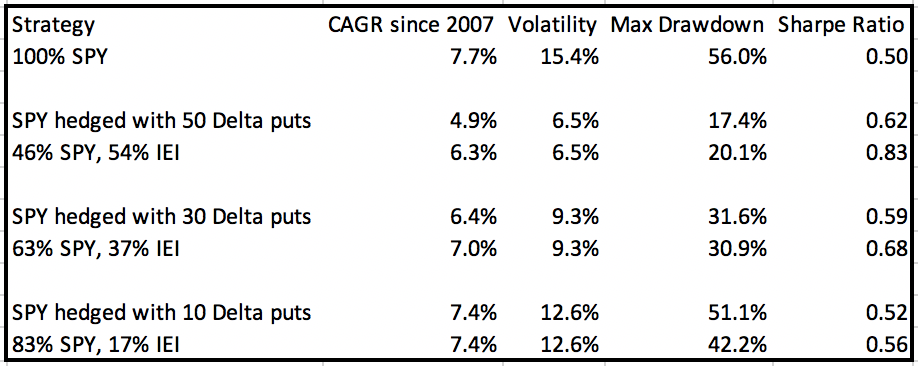
In the following data, I’m showing the hedged portfolios compared to the stock/bond portfolios scaled to have similar volatility. The option hedge parameters entered into the ORATS backtester targets the contract closest to one year from expiration and rolls the contracts at 45 days from expiration. The idea of going further out in time and rolling prior to expiration is to reduce the impact of negative theta (time decay) that you experience with long puts. I did not attempt to optimize the parameters that would result in the best hedging results. With the stock/bond portfolios, rebalancing is assumed to occur based on 5/25 rebalancing bands that can be replicated using Portfolio Visualizer and all results include the reinvestment of dividends. Past performance doesn’t guarantee future results. Now to the data.
 

1608471669_ScreenShot2020-05-11at10_41_50AM.png.f9a337da70958ab6e26d0044dc380029.png


What we see is not surprising based on published research I’ve reviewed from multiple sources. Hedging with puts has been documented to be inefficient due to the volatility risk premium (VRP) built into option prices, making it more effective to simply lower equity allocation and use the proceeds to buy safe bonds (IEI).  A stock/bond ETF or mutual fund portfolio is also much easier and less costly to manage. If buying puts produces poor long-term risk-adjusted results, it then means that selling them may produce attractive long-term risk-adjusted returns. That is the strategy we attempt to capitalize on in the Steady Momentum PutWrite service.


In the AQR podcast episode “diversify or hedge?”, the hosts discuss how a portfolio of equities and cash (or safe bonds, as in my example) produces better long-term results than hedging with puts. AQR also has a research paper titled, “Pathetic Protection: The Elusive Benefits of Protective Puts” which concludes that “because of path dependent outcomes and option expensiveness, put options may do more harm than good.


An alternative approach to protection that investors can take is increasing diversification. ”Hedging with puts" can still be a rational decision if an investor wants to protect from a near or complete loss of value in the stock market (and is willing to pay for it), at which point the outcomes would favor the hedging approach as opposed to the stock/bond approach. The goal of this article is to simply make investors more aware of the different choices they can make with regard to risk management and the expected outcomes related to those choices.


Jesse Blom is a licensed investment advisor and Vice President of Lorintine Capital, LP. He provides investment advice to clients all over the United States and around the world. Jesse has been in financial services since 2008 and is a CERTIFIED FINANCIAL PLANNER™ professional. Working with a CFP® professional represents the highest standard of financial planning advice. Jesse has a Bachelor of Science in Finance from Oral Roberts University. Jesse manages the Steady Momentum service, and regularly incorporates options into client portfolios.


Related articles


What Is SteadyOptions?

12 Years CAGR of 114.5%

Full Trading Plan

Complete Portfolio Approach

Real-time trade sharing: entry, exit, and adjustments

Diversified Options Strategies

Exclusive Community Forum

Steady And Consistent Gains

High Quality Education

Risk Management, Portfolio Size

Performance based on real fills

Subscribe to SteadyOptions now and experience the full power of options trading!
Subscribe

Non-directional Options Strategies

10-15 trade Ideas Per Month

Targets 5-7% Monthly Net Return

Visit our Education Center

Recent Articles

Articles

  • Optimizing Portfolio Growth: Managing Capital and Liabilities in Modern Tax Planning

    Growing your investment portfolio involves more than just picking winners. While strong returns are the goal, many investors overlook a critical factor that significantly impacts their net worth: tax planning. Managing your capital and liabilities with taxes in mind isn't just about saving money in April. It's a year-round strategy that can accelerate your portfolio's growth and help you keep more of what you earn.

    By Kim,

    • 0 comments
    • 539 views
  • Expanded Trading Hours for Select Equity Options

    The Cboe Options Exchange will start offering expanded trading hours for select high-liquidity single-stock equity options. The schedule features a morning Global Trading Hours (GTH) session from 7:30 a.m. to 9:25 a.m. ET and an afternoon Curb session from 4:00 p.m. to 4:15 p.m.

    By Kim,

    • 0 comments
    • 629 views
  • How LEAPS Differ From Short-Term Options

    LEAPS stands for Long-Term Equity Anticipation Security. Which is just a long-dated option, typically referring to those with expirations more than a year out. There’s no technical difference between LEAPS and shorter-term options other than the expiration date. They’re traded on the same exchanges and have the same rules surrounding margin and whatnot.

    By Pat Crawley,

    • 0 comments
    • 31205 views
  • Why Not to Hold Strangles Through Earnings

    In my previous article, I described a strategy of buying a long strangle a few days before earnings and selling them just before earnings. In this article, I will show why it might be not a good idea to keep those strangles through earnings.

    By Kim,

    • 0 comments
    • 6093 views
  • Pre-Earnings Entry Price: What 31,000 Cycles Say

    Every card in the scanner carries a block called How expensive is this entry? It compares what you would pay today against what the same setup cost on the same ticker at the same point in past cycles. I built that block in August. It reads well. But a reading that looks sensible and a reading that predicts something are different things, and until last week I had only the first.


    By Romuald,

    • 3 comments
    • 673 views
  • Expensive Compared to What?

    A trader looks at a pre-earnings straddle and asks whether it is expensive. It is the right instinct and the wrong question, because the word carries no meaning on its own. Expensive against what? A $12 straddle on a $200 stock is not expensive or cheap. It is $12.

    By Romuald,

    • 0 comments
    • 553 views
  • Beyond Strategies: What Options Traders Should Know

    Options education almost always begins with structures. Traders learn vertical spreads, calendars, butterflies, condors, covered calls and straddles, study the expiration diagrams, work out maximum profit and loss, and build a sense of the conditions each structure is supposed to suit. That foundation is necessary and there is no way around it.

    By Kim,

    • 0 comments
    • 1087 views
  • SPX vs SPY Options: Which One Should You Trade? (2026 Guide)

    Both SPX and SPY options give you exposure to the S&P 500. They track the same 500 stocks, move nearly tick-for-tick, and offer the same core strategies — credit spreads, iron condors, butterflies, and 0DTE trades. Yet the two products settle differently, are taxed differently, and carry very different assignment risks.

    By krisbee,

    • 0 comments
    • 5199 views
  • Strike Price Effects Or Pinning Revisted

    Loyal readers of this blog will recall my post from 2019 “Pinning Down the ‘Option Pinning’”. If you have not heard of pinning have a look at that article as – spoiler – everything in it as well as Jeff Augen’s observations in his books which are referenced is still valid.

    By TrustyJules,

    • 0 comments
    • 2346 views
  • Could This Strategy Be The Holy Grail Of Investing?

    This is a reprint of my Seeking Alpha article from 2013. If you have SA subscription, you can read the full article including hundreds of comments here. For the record, the strategy implementation has changed since then, but the principle remains the same. You can read more here

    By Kim,

    • 6 comments
    • 5765 views

  Report Article


We want to hear from you!


Thank you @Jessefor another great article.

How about trying to combine two approaches: hedge but replace SPY with naked puts? If you sell the puts slightly ITM (maybe 1%) every month, you should still keep some nice upside in case SPY rallies, get some premium to pay for the long puts, without sacrificing returns? Kind of a mix between Anchor and Momentum.

Share this comment


Link to comment
Share on other sites

On 4/24/2020 at 3:40 PM, Kim said:

Thank you @Jessefor another great article.

How about trying to combine two approaches: hedge but replace SPY with naked puts? If you sell the puts slightly ITM (maybe 1%) every month, you should still keep some nice upside in case SPY rallies, get some premium to pay for the long puts, without sacrificing returns? Kind of a mix between Anchor and Momentum.


Using ORATS again, this is what a combination of a 55 delta short put and 30 delta long put looks like since 2007:

CAGR: 3.5%
Volatility: 6.13%
Max DD: 12.82%
Sharpe: 0.57

Share this comment


Link to comment
Share on other sites

11 minutes ago, Kim said:

Not very encouraging..


There may be better parameters to run the long put hedge. If you want me to test any other combinations of entries and exits for the hedge, I'm happy to do so. For example, shorter or longer DTE entries as well as exits. A 365 DTE entry and 45 DTE exit made sense to me for managing the negative theta, but there might be different parameters that work better. Tradeoffs to everything, of course.

Share this comment


Link to comment
Share on other sites

What I'm doing for my personal portfolio is the following:

  • Selling SPX puts one month out around 1% ITM
  • Spending 1% of the portfolio on cheap OTM puts (around 2-3 delta) spread over 6-24 months

During the current meltdown, the long puts provided me a very protection dues to the fact that VIX exploded to 80+. I'm not sure how easy it is to test it..

Share this comment


Link to comment
Share on other sites

They say "We find that if your view is for a large and systemic selloff—greater than what is priced by the market— then a volatility-based hedge can potentially make more sense. For smaller and more-fundamentally driven selloffs, directional hedges via equity options may be the more appropriate choice."

Share this comment


Link to comment
Share on other sites

@WayneCthanks for the links, great resources.

I actually looked into VIX calls and compared them to far OTM SPY puts. I looked at the approach of 50 cents trader. Take a look:

https://www.cnbc.com/2018/02/12/the-mysterious-trader-nicknamed-50-cent-made-200-million-last-week-as-the-market-blew-up.html
https://www.reuters.com/article/us-usa-stocks-volatility/big-volatility-options-trade-points-to-mystery-investor-50-cent-idUSKBN1ZS0HW

The strategy involves buying next month OTM VIX calls around 50 cents. 

It paid of very well in the last crash, but the crash was very sharp and quick, and VIX reached 80+ in a matter of few weeks. In case of more gradual decline, the hedge would be less effective, and after the initial decline, the following months VIX futures will become very expensive and not economical for hedging.

Of course you can spread the hedge over few months, but the following months become too expensive. For example, under "calm" markets (VIX in low teens) you can buy the following month 25 calls for 50 cents. But if you go 6-9 months out, then to spend only 50 cents you will need to go up to 40-45 strike.

But maybe some mix of SPY puts and VIX calls can make sense.

Going back to the article, if we take the current crash, we can see that hedging (as represented by our Anchor strategy) worked better than diversification (as represented by Steady Momentum strategy), at least so far. Both strategies reduced portfolio volatility, but Anchor was actually up at some point in March when SPY was down 30%+. @Jesse would you like to comment?

Share this comment


Link to comment
Share on other sites

On 5/2/2020 at 7:19 AM, Kim said:

@WayneCthanks for the links, great resources.

I actually looked into VIX calls and compared them to far OTM SPY puts. I looked at the approach of 50 cents trader. Take a look:

https://www.cnbc.com/2018/02/12/the-mysterious-trader-nicknamed-50-cent-made-200-million-last-week-as-the-market-blew-up.html
https://www.reuters.com/article/us-usa-stocks-volatility/big-volatility-options-trade-points-to-mystery-investor-50-cent-idUSKBN1ZS0HW

The strategy involves buying next month OTM VIX calls around 50 cents. 

It paid of very well in the last crash, but the crash was very sharp and quick, and VIX reached 80+ in a matter of few weeks. In case of more gradual decline, the hedge would be less effective, and after the initial decline, the following months VIX futures will become very expensive and not economical for hedging.

Of course you can spread the hedge over few months, but the following months become too expensive. For example, under "calm" markets (VIX in low teens) you can buy the following month 25 calls for 50 cents. But if you go 6-9 months out, then to spend only 50 cents you will need to go up to 40-45 strike.

But maybe some mix of SPY puts and VIX calls can make sense.

Going back to the article, if we take the current crash, we can see that hedging (as represented by our Anchor strategy) worked better than diversification (as represented by Steady Momentum strategy), at least so far. Both strategies reduced portfolio volatility, but Anchor was actually up at some point in March when SPY was down 30%+. @Jesse would you like to comment?


I'm waiting for a response from Matt at ORATS about a question related to the backtesting output...I've found a discrepancy that doesn't make sense to me, and might be causing the backtest to be displaying results that are worse than they should based on if you enter the backtest as a "married put" strategy vs. a "protective put" strategy. I backtested based on "married put", but if I change it to "protective put", the results are much better for the hedged strategies. If that turns out to be true, I'll need to update the article with corrected numbers, but until I hear back from Matt I'm not sure so we'll have to standby.

Share this comment


Link to comment
Share on other sites

On 5/4/2020 at 10:17 AM, Jesse said:


I'm waiting for a response from Matt at ORATS about a question related to the backtesting output...I've found a discrepancy that doesn't make sense to me, and might be causing the backtest to be displaying results that are worse than they should based on if you enter the backtest as a "married put" strategy vs. a "protective put" strategy. I backtested based on "married put", but if I change it to "protective put", the results are much better for the hedged strategies. If that turns out to be true, I'll need to update the article with corrected numbers, but until I hear back from Matt I'm not sure so we'll have to standby.


I've updated the data in the chart based on discussions with ORATS to make sure the backtest is being simulated properly. The hedged portfolios now looks better than before, although still less attractive on a risk-adjusted basis relative to stock/bond portfolios that have been scaled to have the same volatility as the hedged portfolios. The hedged portfolios also don't factor in the cash outlay required to buy and roll the hedge, so this essentially simulates buying the puts interest free on margin. If that were properly accounted for, by either deducting applicable margin interest, or if not using margin reducing the quantity of SPY, results would be slightly worse than shown.

Share this comment


Link to comment
Share on other sites


Join the conversation

You can post now and register later. If you have an account, sign in now to post with your account.
Note: Your post will require moderator approval before it will be visible.

Guest
Add a comment...

×   Pasted as rich text.   Paste as plain text instead

  Only 75 emoji are allowed.

×   Your link has been automatically embedded.   Display as a link instead

×   Your previous content has been restored.   Clear editor

×   You cannot paste images directly. Upload or insert images from URL.

Loading...