

SteadyOptions is an options trading forum where you can find solutions from top options traders. Join Us!

We’ve all been there… researching options strategies and unable to find the answers we’re looking for. SteadyOptions has your solution.

Maximize Returns With Option Overlays


Investors in 2018 are faced with a challenging investing environment for both US stocks and bonds. So what can an investor do to increase portfolio returns without taking on too much additional risk? Those comfortable with and capable of trading simple option income strategies like strangles may be able to accomplish this objective.  

A popular option strategy is the short strangle, which consists of selling an out of the money put and call. My personal backtesting and real trading experience is that this strategy on equity market ETF's or cash settled indices can increase portfolio diversification and if overlaid on a portfolio of underlying assets like mutual funds or ETF's can also increase total returns. 


When you sell a strangle, you bring cash into your account. By doing so, you can "overlay" this trade on top of a portfolio consisting of ETF's or other investments without paying margin interest. Before we get too deep into the weeds, lets deal with the elephant in the room...you've heard strangles are risky. Is that true? The answer isn't that simple, as the trade isn't what measures risk, instead, it's the position size. Excessive leverage is risky, but strangles don't have to be traded this way. I'd encourage every option trader to not only consider the margin requirement of any particular option trade, but the notional risk. For example, think in terms of a 1 contract SPY strangle with SPY trading at $280 as theoretically being a $28,000 position (stock price X 100), similar to how buying 100 shares of SPY at $280 is a $28,000 position. When sized this way, a typical strangle will actual have less risk than the underlying asset.


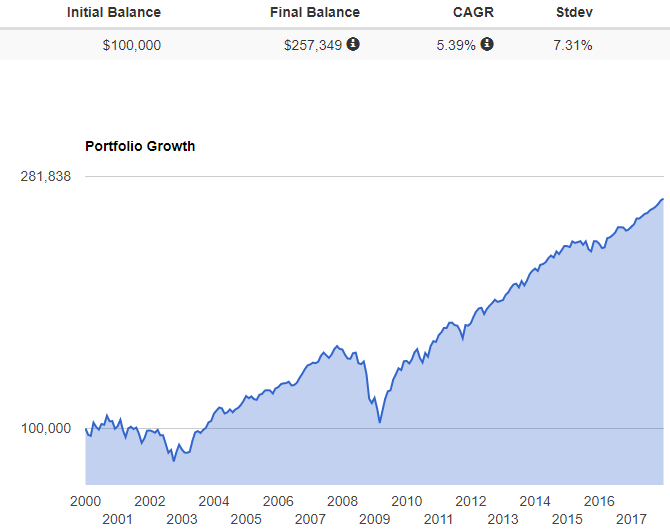
With this in mind, let's look at a rough example of how we could implement this idea in a $100,000 account. First, we'll look at the performance of a 50/50 stock/bond portfolio that is rebalanced monthly since 2000.
 

1.png


This portfolio would have returned a little over 5% annually, with a standard deviation of 7.31%, producing a Sharpe Ratio of 0.54. 


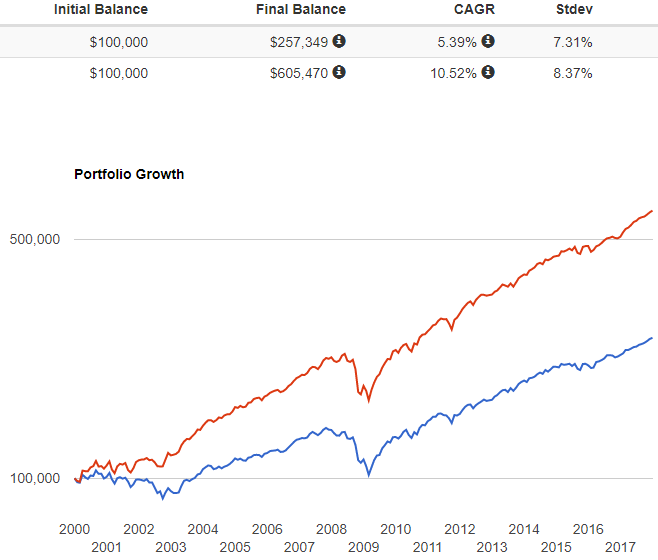
Next, we'll add a 50% strangle allocation to this same portfolio. Yes, this equals 150%, which does make this concept only possible in a taxable margin account. The strangle allocation is based on our own backtesting platforms and proprietary rule sets and includes hypothetical trades on both SPY and IWM. A trader would sell 2 strangles on SPY in a $100,000 account to approximately replicate the concept. 


Blue: Stock/Bond Portfolio

Red: Stock/Bond/Strangle Portfolio
 

 2.png


The 50/50/50 portfolio nearly doubles the annualized return to over 10%, and only with a modest increase in standard deviation to 8.37%. This increase in risk adjusted return substantially improves the portfolio Sharpe Ratio to 1.05. Even with a 50% increase in total portfolio allocation, the portfolio risk only slightly increases due to the low correlation of the strangle strategy to both stocks and bonds. This example is only meant to show the concept of an option overlay in action, and the potential benefits of doing so. Many other creative ideas could be implemented with other underlying assets and option strategies. My investment advisory firm, Lorintine Capital, currently implements these concepts in managed accounts as well as in one of our private funds, LC Diversified Fund. We are happy to have discussions with investors interested in a professionally managed solution, or ideas on how to implement this concept on their own.  


Jesse Blom is a licensed investment advisor and Vice President of Lorintine Capital, LP. He provides investment advice to clients all over the United States and around the world. Jesse has been in financial services since 2008 and is a CERTIFIED FINANCIAL PLANNER™. Working with a CFP® professional represents the highest standard of financial planning advice. Jesse has a Bachelor of Science in Finance from Oral Roberts University. Jesse is managing the LC Diversified portfolio and forum, the LC Diversified Fund, as well as contributes to the Steady Condors newsletter. 

What Is SteadyOptions?

12 Years CAGR of 114.5%

Full Trading Plan

Complete Portfolio Approach

Real-time trade sharing: entry, exit, and adjustments

Diversified Options Strategies

Exclusive Community Forum

Steady And Consistent Gains

High Quality Education

Risk Management, Portfolio Size

Performance based on real fills

Subscribe to SteadyOptions now and experience the full power of options trading!
Subscribe

Non-directional Options Strategies

10-15 trade Ideas Per Month

Targets 5-7% Monthly Net Return

Visit our Education Center

Recent Articles

Articles

  • Optimizing Portfolio Growth: Managing Capital and Liabilities in Modern Tax Planning

    Growing your investment portfolio involves more than just picking winners. While strong returns are the goal, many investors overlook a critical factor that significantly impacts their net worth: tax planning. Managing your capital and liabilities with taxes in mind isn't just about saving money in April. It's a year-round strategy that can accelerate your portfolio's growth and help you keep more of what you earn.

    By Kim,

    • 0 comments
    • 238 views
  • Expanded Trading Hours for Select Equity Options

    The Cboe Options Exchange will start offering expanded trading hours for select high-liquidity single-stock equity options. The schedule features a morning Global Trading Hours (GTH) session from 7:30 a.m. to 9:25 a.m. ET and an afternoon Curb session from 4:00 p.m. to 4:15 p.m.

    By Kim,

    • 0 comments
    • 483 views
  • How LEAPS Differ From Short-Term Options

    LEAPS stands for Long-Term Equity Anticipation Security. Which is just a long-dated option, typically referring to those with expirations more than a year out. There’s no technical difference between LEAPS and shorter-term options other than the expiration date. They’re traded on the same exchanges and have the same rules surrounding margin and whatnot.

    By Pat Crawley,

    • 0 comments
    • 31036 views
  • Why Not to Hold Strangles Through Earnings

    In my previous article, I described a strategy of buying a long strangle a few days before earnings and selling them just before earnings. In this article, I will show why it might be not a good idea to keep those strangles through earnings.

    By Kim,

    • 0 comments
    • 6020 views
  • Pre-Earnings Entry Price: What 31,000 Cycles Say

    Every card in the scanner carries a block called How expensive is this entry? It compares what you would pay today against what the same setup cost on the same ticker at the same point in past cycles. I built that block in August. It reads well. But a reading that looks sensible and a reading that predicts something are different things, and until last week I had only the first.


    By Romuald,

    • 3 comments
    • 531 views
  • Expensive Compared to What?

    A trader looks at a pre-earnings straddle and asks whether it is expensive. It is the right instinct and the wrong question, because the word carries no meaning on its own. Expensive against what? A $12 straddle on a $200 stock is not expensive or cheap. It is $12.

    By Romuald,

    • 0 comments
    • 456 views
  • Beyond Strategies: What Options Traders Should Know

    Options education almost always begins with structures. Traders learn vertical spreads, calendars, butterflies, condors, covered calls and straddles, study the expiration diagrams, work out maximum profit and loss, and build a sense of the conditions each structure is supposed to suit. That foundation is necessary and there is no way around it.

    By Kim,

    • 0 comments
    • 949 views
  • SPX vs SPY Options: Which One Should You Trade? (2026 Guide)

    Both SPX and SPY options give you exposure to the S&P 500. They track the same 500 stocks, move nearly tick-for-tick, and offer the same core strategies — credit spreads, iron condors, butterflies, and 0DTE trades. Yet the two products settle differently, are taxed differently, and carry very different assignment risks.

    By krisbee,

    • 0 comments
    • 4888 views
  • Strike Price Effects Or Pinning Revisted

    Loyal readers of this blog will recall my post from 2019 “Pinning Down the ‘Option Pinning’”. If you have not heard of pinning have a look at that article as – spoiler – everything in it as well as Jeff Augen’s observations in his books which are referenced is still valid.

    By TrustyJules,

    • 0 comments
    • 2211 views
  • Could This Strategy Be The Holy Grail Of Investing?

    This is a reprint of my Seeking Alpha article from 2013. If you have SA subscription, you can read the full article including hundreds of comments here. For the record, the strategy implementation has changed since then, but the principle remains the same. You can read more here

    By Kim,

    • 6 comments
    • 5637 views

  • Like 1
  • Thanks 1
  Report Article


We want to hear from you!


Thank you Jesse for a very interesting perspective of selling strangles.

As many of you know I'm not a big fan of selling naked strangles. However, as Jesse mentioned to me, people think they are ‘risky’ b/c of horror stories like Karen the ST…but it’s not about the trade that made what she did risky, it was excessive leverage.

The bottom line is that a short strangle by itself is not necessarily "risky" if it's done with responsible position sizing. 

Share this comment


Link to comment
Share on other sites

I agree 100% - "risk" is not defined strictly by the type of position, but by proximity between strikes and resistance/support, moneyness of option to current price, volatility level, and number of positions opened. One of the great problems in the industry is a perception that risk is identified simply by the title of the trade. It is more complex.


Share this comment


Link to comment
Share on other sites

Interesting article Jesse - would be a lot stronger / more substantial with a) guidance on what deltas to sell and b) what deltas were sold in the back testing of the strategy from 2000 (assuming a consistent strategy was applied).

Do those backtested returns imply being short the strangle through expiration? 

What's the plan for managing it if under pressure?

Thanks, Sam


Share this comment


Link to comment
Share on other sites


Join the conversation

You can post now and register later. If you have an account, sign in now to post with your account.
Note: Your post will require moderator approval before it will be visible.

Guest
Add a comment...

×   Pasted as rich text.   Paste as plain text instead

  Only 75 emoji are allowed.

×   Your link has been automatically embedded.   Display as a link instead

×   Your previous content has been restored.   Clear editor

×   You cannot paste images directly. Upload or insert images from URL.

Loading...