
All Activity
- Today
-
 A lot of people are wondering if they should buy Bitcoin. A lot of people are also wondering if it is a viable option to the methods of payment we currently have available. We can all agree that the idea of peer-to-pun currencies like cryptocurrencies is ingenious! Are you wondering if you should purchase Bitcoin? Keep reading to learn the answer to this question and more! What Is Bitcoin? When considering buying Bitcoin, it is important to understand what Bitcoin is. Bitcoin is a digital currency that is decentralized and can be used as an investment and as a means of payment. Transactions are verified and approved using cryptography, which helps to ensure their security. Platforms and analytics services often read blockchain transaction records using an onchain data API so balances and transfers can be tracked accurately across the network. Bitcoin can also be used as a store of value and a medium of exchange like traditional currencies. Investing in Bitcoin has its advantages as it can potentially provide a higher return on investment than traditional currencies. But, it is also known to be volatile and can be affected by many external factors. So, it is important to research further and understand the implications of investing in Bitcoin before purchasing any coins. Uses of Bitcoin It is a digital currency with many potential uses. It can be used to purchase goods and services online, as well as to make payments to people all over the world. It can also be used for investment purposes, as it is an extremely volatile asset with the potential for significant returns. It is essential to consider the risk involved with investing in this relatively new asset class. It is also not supported by any central bank, so the user must take all responsibility for the security of their funds. For these reasons, it is important to do your research and think carefully about whether investing in Bitcoin is right for you. Different Types of Bitcoin Investors It is crucial to know the different types of Bitcoin investors. First, some invest for long-term gains. They usually have a good understanding of the cryptocurrency and expect its growth. Second, some traders buy with the hopes of making short-term profits by selling it at a higher price. Lastly, some speculators buy based on rumors and news. They are likely to take greater risks for a higher reward. The investor should decide whether their risk tolerance and goals are aligned with the respective type of Bitcoin investor before buying. With educated speculation, the proper outlook, and a long-term mindset, investors can achieve success with Bitcoin. Understanding the Legal and Regulatory Environment It is important to understand the legal and regulatory environment of Bitcoin. Bitcoin is treated differently by different countries in terms of taxation, as well as regulatory compliance. For example, some countries may tax Bitcoin acquisitions as capital gains while others may not. Moreover, individuals should be aware of the regulations in their jurisdiction in terms of exchanging, trading, and otherwise using Bitcoin. It is recommended that users consult with a financial or legal advisor to understand the legality and regulatory environment of buying, selling, and using Bitcoin. Furthermore, one should always be extra cautious when handling digital assets since they are not always insured or protected in the same way as traditional asset classes. With a full understanding of the legal and regulatory environment of Bitcoin, it is then up to the individual to decide if they wish to purchase Bitcoin. Calculate the Potential Risks and Benefits of Investing It is also vital to consider the potential risks and benefits of Bitcoin associated with cryptocurrency. On the one hand, it is decentralized, meaning it is not regulated by any government or bank. It can be seen as a benefit and a downside because it makes it volatile and subject to market forces. Also, the profit potential is high in uncertain economic times, as it has the potential to appreciate rapidly. It is also important to consider the potential security risks as a digital currency can be subject to cyber thieves or hackers. It is vital to understand the technology behind Bitcoin, as well as the market forces. It is also a good idea to use a wallet specifically for Bitcoin transactions, as it will provide an extra level of security. Ultimately, investing in one is a personal decision that requires careful consideration of the potential risks and benefits. How to Buy Bitcoin Bitcoin is a digital currency, meaning that it can only be used online. To purchase Bitcoin, one must first find a reliable exchange where they can buy and store it securely. After finding a trusted exchange, the user will create an account before depositing their traditional currency. Once the transaction is complete, the user will then become the owner of Bitcoin. The decision to buy Bitcoin is an individual one. Check this to find out more about how to buy cryptocurrency in another country. Potential buyers should weigh the risks and rewards before considering an investment. Should I Buy Bitcoin? Weigh Your Needs Investing in Bitcoin can be a risky endeavor. But, with the proper research and understanding, it can also be a lucrative investment with the potential for future growth. It depends on your existing circumstances and the level of risk you're willing to take. It could potentially pay off big if you invest wisely, but as with any form of investing, there is associated risk. If you're considering buying Bitcoin, do your homework and talk to financial professionals before proceeding. Investing is always a gamble, so it’s best to make informed decisions when it comes to your finances. This is a contributed post
 -

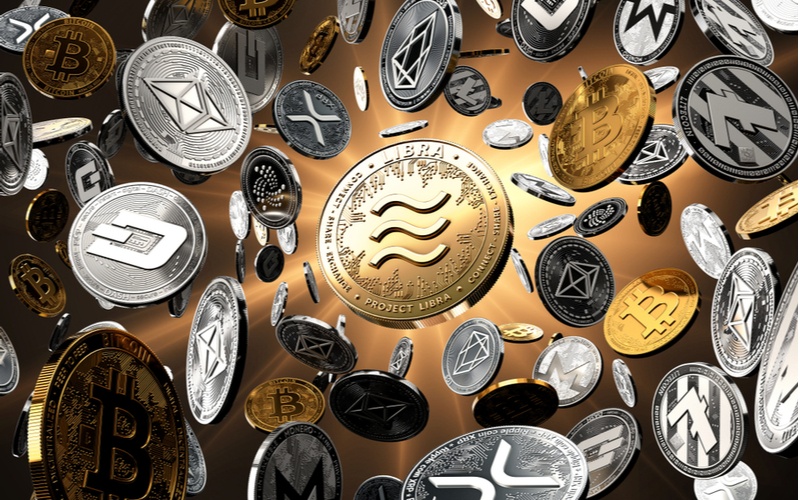 So without further ado, let’s walk through some of the most common red flags below. Be Careful About Reputation You’ve heard about a great new currency you like the sound of, and it’s doing well on the market right now. You want to get involved and invest, and that’s great too. But before you do, double check where this currency has come from. What information is publicly available about the creator(s)? Look for white papers, read up on forums, and look for past projects they may have gone into. The latter is incredibly important, as you need to know what (if any) projects these creators have worked on before, as well as what ended up happening to them. Don’t Take Anyone at Their Word If a friend told you about a cryptocurrency they’d invested in, and they were pleased with the way it was performing, would you immediately invest in it too? There’s a chance, because you know this person and you trust them. But never take anyone at their word. You first need to know for yourself what ‘performing well’ really means. Avoid Anyone Trying to Rush You This is a classic scam technique. The person trying to get your details and/or money makes you feel like there’s a time limit on making a decision. That sense of urgency is going to be what trips you up more than anything else. Of course, in the world of crypto, a scammer is unlikely to tell you that you’ll be going to prison unless you invest in their new currency. Instead, they’re going to play on hype in the form of ‘FOMO’, as no one wants to miss out on a great investment while the market looks strong. Hype can be dangerous Buy into the hype and you might end up putting all of your investment fund into a currency, only for the same person who encouraged you to invest to turn around and ‘pump and dump’ it. This result is quite common across social media, with various content creators and influencers hyping up certain currencies to their audience. Even if they don’t intend to run a pump and dump scheme, they still end up being one of the few people who actually made a return. Once again, never just take a public figure at their word. Conduct your own checks and make your own decisions. Staying Safe with Crypto: Top Tips Now you know some common red flags, how do you actually avoid falling prey to them? For one, always approach the crypto market with a healthy sense of skepticism. If you want to be an experienced trader one day, you need to take your time with the market. But there’s a couple of other things you should do to stay safe as well: Find out as much as you can about chains No crypto investor should be just be slinging their coins around without any care. The market for crypto isn’t regulated in the same way usual financial markets are - and that’s one of the main appeals of investing in crypto. You can make money, you can move money, and you can keep your crypto investments in whatever place is best for you. All you need is access to trading platforms and your own wallet. But even with this freedom to grow your investment, you need to be careful about this decentralized aspect. If you’re using a non-centralized platform to trade, that’s one thing. But with new currencies and chains being launched at break-neck speed, you always need to be in the loop. Use a clever bit of automation to help yourself out here. Sign up to block explorer software that lets you investigate blockchain in the same way you’d tap something into Google to find out more. You can even launch custom a block explorer to uncover and track the specific targets you’re interested in, and you don’t even need to be a tech expert to get it up and running. Keep your accounts secure by following best safety practices We all know the standard online safety rules, right? If you don’t, we’re here to serve you a quick reminder. Make a strong password and never share it with anyone, no matter how close they are to you. Try not to share private details with strangers. You’ll be making traders across platforms, both public and private, but you should be protected by that platform’s encryption system. Turn on 2 factor authentication, if you can. If someone needs both your actual password and a code sent to your phone or email, they’re not going to get into your account. Crypto Trading: Take Note of a Red Flag When You See One There’s quite a few to be on the lookout for, and that can be a worry. You don't want to miss a single hint of red whenever you’re looking into a new chain or currency. But all in all, you may just need to trust your gut here. After all, we’ve all been taught the golden rules of keeping your money safe: Get rich quick schemes don’t exist Everyone is trying to sell you something These rules are usually the basis of all our money decisions in adult life. Stick to them in the crypto world and you’re far less likely to fall for any red flags pretending to be green ones. When you’re trading crypto from the comfort of your own home, don't let the ease of this kind of investing lull you into a false sense of security. Stay sharp, stay smart, and stay safe. This is a contributed post.
 -
 Building wealth is a sprint; it rewards speed and concentration. Protecting wealth is a marathon; it rewards patience and design. The strategies that brought you to where you are today may not be those that protect what you have created. The concept of diversifying is no longer a chase for upside as much as designing an intentionally, flexible and secure lifestyle. Redefining Risk After Success Risk can be thrilling when you're climbing, and taking an opportunity at risk can turn things around fast. At some point, as you build wealth, risk will start to feel differently; a bad decision could undo all you've worked for over many years. When this happens, diversification isn't just buying more things. Rather, it's identifying areas of exposure. While many successful individuals may own large amounts of money in one type of business, one asset class, or one geographic area, they continue to hold a high level of concentrated risk. That same concentration can become a silent threat to their long-term financial stability. Take a hard look at how much of your total wealth is tied up in a single industry. Next, think about how liquid your assets really are? Finally, ask yourself what would happen if interest rates rose, markets were unable to sell positions, or your primary source of income was reduced? To preserve what you have, first, be honest about the areas of vulnerability. Don't pull all of your assets out into cash and hide. Instead, spread your risks in ways that seem intentional rather than reactionary. Building A Layered Asset Structure Wealth preservation works best when assets serve different roles. Some provide growth. Some generate income. Others create optionality. Public equities will remain important; however, their objective may be changing. Rather than pursuing speculation, public equity investors should seek to invest in stable companies with solid financials and consistent cash flows. Dividend income now appears appealing as it creates an opportunity for a more controlled sale strategy during market volatility. Bonds have never been sexy; however, bonds have historically smoothed out the variability of investment returns. In addition, bonds provide a known income stream regardless of what happens in the markets. This is particularly true if the bond portfolio has been constructed through a mix of various maturity dates. Private investments will likely continue to be relevant, however, private equity investors will need to be cautious of position sizing. The days of investing a large portion of your portfolio into one single start-up or fund are coming to an end. Private equity investors will need to allocate smaller portions of their portfolio among multiple funds or managers. The goal here is to reduce the risk of one event determining your future. Think about your portfolio in layers. Top layer growth (i.e., the companies with the greatest potential); middle layer stability (i.e., the companies that generate the most free cash flow); bottom layer liquidity (i.e., the cash available to meet short-term obligations). As markets fluctuate, you will be better able to manage your emotions if you have a balanced portfolio rather than a panicked one. Real Estate With Purpose Real estate often becomes a cornerstone for those who have reached financial independence. It offers tangible value and the potential for steady income. Yet owning property without a clear plan can create complexity rather than security. Diversification within real estate matters just as much as diversification in stocks. Residential properties behave differently than commercial ones. Markets in the Midwest do not mirror coastal cities. Short term rental demand can shift quickly based on tourism trends. Professional systems can make a real difference here. Many investors rely on rental property management software to track performance, manage tenants, and keep expenses organized. When used well, it turns a collection of properties into a disciplined operation. That level of clarity supports preservation because it reduces surprises. It is also worth considering real estate investment trusts for additional exposure without direct management responsibilities. They provide liquidity and professional oversight while still offering access to property markets. Expanding Beyond Traditional Investments The inclusion of art, collectibles, and direct business investment can provide a richer experience for your portfolio (financially and emotionally). These types of investments require knowledge, time and are not substitutes for your core holdings, but they can be used to support them. Strategic giving through philanthropy using tools such as donor-advised funds or private foundations is also part of the diversification conversation. Strategic giving can help with tax efficiency, while allowing you to build your legacy. Many times, strategic giving is used by families to bring their members together around common goals, and can even become one of the ways that you use charitable planning. Family investments in education and/or experiences will never show up on a balance sheet, however, these can make your wealth more resilient over the long-term. If you fund the education of your children beyond what would have been expected, or if you invest in a business venture within your family, you may be able to generate future income from those ventures and establish a sense of community among your family members. At this point, your diversification efforts are no longer about making money. Diversification at this point is about creating a "life architecture" that reflects who you are today. Designing For The Next Generation True wealth preservation involves planning past one's death. A true diversified investment portfolio also needs to reflect the interaction of the heirs with their inheritance. Educating your heirs on money matters is very important. Structured exposure to heirs' making financial decisions as they grow up can help prevent them from making poor financial choices. Family meetings that include discussions on investments, philanthropy, and long-term family objectives increase transparency. You may want to consider staggering inheritances, or tying incentives to trusts in order to encourage productive activity by the heirs. However, this does not have to involve controlling your heirs from beyond the grave. Rather it creates an environment which encourages growth and independence rather than dependency. Moving from wealth building to wealth preserving is a powerful transition. It reflects achievement and foresight. Diversification becomes a tool for stability, flexibility, and legacy rather than a buzzword. At this level, the question is no longer how fast you can grow. It is how thoughtfully you can protect. Preservation is not passive. It is active stewardship. It honors the effort that built your wealth in the first place while ensuring that it continues to serve you, your family, and your community for decades to come. This is a contributed post
 - Yesterday
-
 Edwim joined the community
 - Last week
-
Back up for me. Many thanks.
-
Should be back to normal
- 1096 replies
-
- 1
-

-
- volatilityhq.com
- volatilityhq
- (and 1 more)
-
I was doing some backend upgrade that should not be causing issues, but there are issues with the website right now that i'm investigating, sorry about that.
-
 Julien SUPIOT joined the community
 - Earlier
-

Option Commander - Trading Terminal for Interactive Brokers
andrey748 replied to andrey748's topic in Promotions and Tools
A build for Apple Silicon has been created; you can try it out. One feature isn't working yet - the Order Control panel needs to be redesigned for Mac. I'll work on it and have it done by the end of the week. It's not the most important feature, but the basic functionality works. Give it a try! -
Option Commander - Trading Terminal for Interactive Brokers
andrey748 replied to andrey748's topic in Promotions and Tools
Currently only for PC, maybe I'll add Mac in the future -

Option Commander - Trading Terminal for Interactive Brokers
NuclearMaple replied to andrey748's topic in Promotions and Tools
Does it work with Mac OS? -
Hey everyone! I've been using OptionVue and later ONE for a long time. They're decent tools, but I kept hitting the same issues - lagging interface, unreliable order submission, broken fill imports, clunky modeling, and no strategy templates. So I built my own terminal that solves these problems: - Speed. Everything is fast with no lag - quotes, order execution, loading fills. - Flexible modeling. More convenient position modeling with support for custom strategy templates. - Accurate calendar spread what-if analysis. Volatility changes are modeled independently across different expirations, so you get realistic projections. It also includes a number of other features: strategy builder with entry conditions, volatility cone analysis, Kelly criterion calculator, trade copy-paste, historical price distribution analysis, the ability to send orders to two TWS instances for mirroring trades to a second account, and futures-based SPX price tracking during off-hours. On the practical side - there's a convenient backup/restore to Google Drive so your data is safe and not tied to a specific machine. Everything runs locally, no data is sent to the cloud. And authorization is handled once, so you don't have to log in manually every time. I'd love to get any feedback. Happy to answer questions about setup or how it works. Download and start a free 14-day trial at https://optioncommander.com/
-
 Joshbarr4 joined the community
 -
 bgricker joined the community
 -
SO can be more than 50% invested during busy earnings periods, so you would need to reduce the position sizing. And your drawdowns might be higher as well, so it would be more risky. But overall, yes, it can be done, although generally speaking, I always recommend not to invest 100% of the account and have at least 20-30% in cash (or less risky assets).
-
SO has all trades listed because it's a lot of trades using different strategies. Services like SY and SV have only 2-3 trades every month, so it's very easy to track the P/L. For example, SY January return of 4% is based on 4 trades closed in January: If you sum the P/L of each trade (291+208+305-326), you will see how we report 4% ($400) return. SV is even simpler - it is typically a single trade per month.
-
Hi Kim, looks like a fantastic service with a bright future, especially with Yowster managing it, who i know from steady options is incredibly smart and reliable. I think i will likely end up purchasing this too in the future, my question is: given that this is only usually 50% invested, and so is steady options, would it be a silly idea to make that 100% of my portfolio? Could you share some more info on the types of trades and the greeks? Thanks!
-
Kim, New to service, and trying to understand the history of the services, in particular SteadyYields. SteadyOptions has a decent set of details, outlining the trades for (say) 2025. But I cannot find a corresponding set for any of the other services, only aggregates. SY appears to have a "bit of history", but it seems difficult to assemble a complete history of trades, PnL, DrawDown, Risk incurred, Position size in order to have a better understanding of what to expect. Any tables/data appreciated - Phil
-
 Bens joined the community
 -
.thumb.jpg.3ed143eeb45acb89ba43287757ccbd6b.jpg) Personal MBA Coach changed their profile photo
Personal MBA Coach changed their profile photo -
Personal MBA Coach joined the community
-
 thetechguy joined the community
 -
 huynhchinhthuan91069 joined the community
 -
thanks for the information!
-
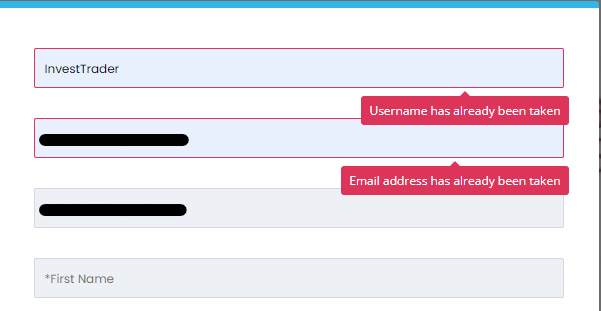
Hi, sorry to hear about that. I cannot find "InvestTrader" in the members. Can you please give me the email address in order for me to find you among all the subscribers? Thanks, Romuald
-
Hi @Romuald A few months ago I registred in your site (the free plan). Now I'm trying to activate a paid subscription. I login, go to the subscriptions page, click on the desired plan and nothing happens. There is no response. If I logout and go to the subscriptions page, then I can access the form to activate the subscription. However, when I start inserting my data, the site rejects it saying that they already exist (which is correct). How can I activate the paid subscription? Thanks In Advance!
-
It’s the friday before the earning. Each earning date is not always on the same day of the week (Monday, Tuesday, etc) so it’s not always the same T-X. Another thing is that the data does until the Thursday because on friday end of day there is no data for that option that is expired.
-
@Djtux Looking at the double calendar RV charts with short leg before earnings, 1 week between calendar legs, weekly options, the black median line ends on different days before earnings date. Sometimes it is on Thursday Friday or Monday. It can be -2 -3 -4 trading days. What is the rule here? I would expect it always to be on a Friday since the calendar's front leg expires
-

Spreadable Mobile Trading App created for Steady Options
mabueh replied to Bull3t007's topic in Promotions and Tools
The app works really well and is quite intuitive - I use it on a daily basis. If I am not mistaken, it is however available only on Apple products and also not accessible in browsers. -
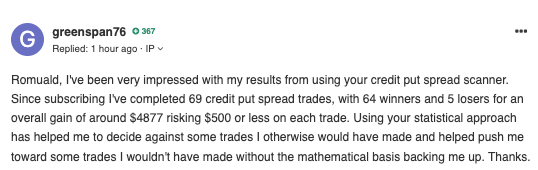
Here's a message I received today that's always a pleasure! I'm delighted that greenspan76 was able to earn this money thanks to my website math-trading.com!
-

Spreadable Mobile Trading App created for Steady Options
Bull3t007 replied to Bull3t007's topic in Promotions and Tools
I have built it and have been using it for three years now. It’s great;) -

Spreadable Mobile Trading App created for Steady Options
MikeMike replied to Bull3t007's topic in Promotions and Tools
I anyone using this app? I have been looking to switch to Tradier, but need to trade via mobile much of the time. If this app works well it would solve that issue for me. Thanks. -

Chartaffair.com - RV Charts & Backtesting for Steady Options
ocr008 replied to Christof+'s topic in Promotions and Tools
I want to cancel my subscription chartaffair please help -

Spreadable Mobile Trading App created for Steady Options
lisamontgom replied to Bull3t007's topic in Promotions and Tools
thanks for the information!