

SteadyOptions is an options trading forum where you can find solutions from top options traders. Join Us!

We’ve all been there… researching options strategies and unable to find the answers we’re looking for. SteadyOptions has your solution.

Investors Are Not As Smart As The Media Thinks


Over the last decade there has been a substantial rise in proclamations such as “investment advisors are useless,” “manage your own assets,” “don’t pay for financial advice,” and other similar sentiments. 

In fact, almost every major publication on investing from Business Insider to Forbes to the Wall Street Journal has written pieces on the topic of “people don’t need to pay someone to manage their investments.”  (Business Insider, Aug. 12, 2016). The only problem with that is it is bad advice.
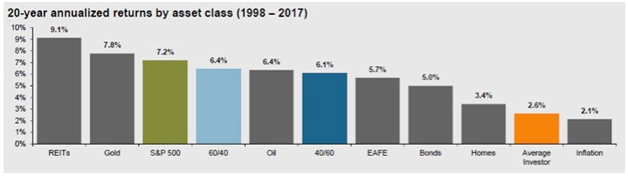
 

image.png


What is this chart?  It’s a study done by Dalbar, Inc., in conjunction with JP Morgan, studying thousands of self-managed investment accounts, as compared to other asset classes from 1998-2017.  Notice the worst performing class?  The average investor.  This is also only the average – meaning that there are substantial numbers of self-managed investors that do much, much, worse. This same study identifies three primary reasons for investor failure:
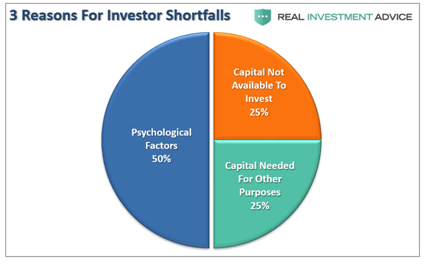

image.png


Notice something?  Advisory fees are not on there.  The single biggest factor is psychological.  This can be from risk aversion, which leads to panic selling; narrow framing which results from making investment decisions without looking at the effect on an entire portfolio; anchoring, which is focusing on the recent past; lack of diversification, or not understanding what diversification really is and how market moves effect all of your assets; herding, following what everyone else is doing which often leads to buying high and selling low; regret, which causes individuals to not perform actions necessary due to past failures (or the “make up that loss mentality”); optimism, which leads to making decisions not based in reality; and a host of other factors.


As shown above, other things also impact investor performance.  For instance, an investor might need a new car, so sells off some of his investments.  But did he think about how that would impact his portfolio or returns?  Did he make an educated decision in liquidation order?  Did he consider taxation or the current market?


In short, investors, as a class, are wholly incapable of making regular positive investment decisions for their own benefit.


The common response to the above is, “well most advisors rarely beat the indexes, so why pay one?”  First, as shown above, the average investor not only doesn’t beat the indexes, they lag substantially behind. 

But let’s break this down even further.  It is almost impossible for most advisors to beat the indexes in any one year. Not because they make poor investment decisions, don’t know what they are doing, or have the same issues as the average investor.  Rather it’s because index returns don’t count the following:


  1. Taxes – even if it is just from reinvesting dividends in a long term portfolio, taxes will still be a drag on any portfolio that is not reflected in the index an investor may be tracking.  If an investor just owned SDY, which has a yield of about 2.5%, and re-invests those dividends, that will act (depending on your tax bracket) as a drag of about 0.5% on your portfolio returns;
     
  2. Transactional Fees – even with the rise in low transaction costs, most accounts still have fees to buy and sell investments.  Assume you’re funding your IRA monthly with $458/month so as to max it out by the end of the year.  The average transaction cost right now is about $5, meaning you’ll have another 0.1% drag per year, based on transaction costs (and that’s if you can re-invest dividends for free, if you can’t that amount may double);
     
  3. Fund/ETF Costs – ETFs have gotten quite cheap in the last ten years, but it’s rare to find one that is truly free.  SPY’s expense ratio is only 0.0945% -- but that is still another ten basis points on which an investor will lag the index.


The above three factors alone means any “index” investor will lag the indexes by at least 0.7% per year.  Measuring performance against indexes, while helpful, needs to be done with an understanding of the above.


So should most people use an advisor?  Of course they should. (Note, I did not say all, but rather “most”).  Even Vanguard, the king of low cost index investing, is a proponent of advisors.  In a study and review of advisors, Vanguard has concluded that a good advisor adds three percent (3.0%) of alpha to the average investor. 
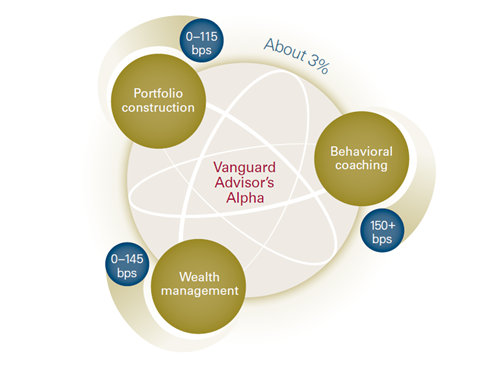
 

image.png


Notice the biggest value comes from behavioral coaching – which is in line with what Dalbar and JP Morgan found.


Conclusion?  Don’t believe everything you hear, you can find value in surprising places.

Related articles:


What Is SteadyOptions?

12 Years CAGR of 114.5%

Full Trading Plan

Complete Portfolio Approach

Real-time trade sharing: entry, exit, and adjustments

Diversified Options Strategies

Exclusive Community Forum

Steady And Consistent Gains

High Quality Education

Risk Management, Portfolio Size

Performance based on real fills

Subscribe to SteadyOptions now and experience the full power of options trading!
Subscribe

Non-directional Options Strategies

10-15 trade Ideas Per Month

Targets 5-7% Monthly Net Return

Visit our Education Center

Recent Articles

Articles

  • Delta-Neutral Options Strategies for Earnings

    Most options trading starts with a directional guess: you think a stock goes up, so you buy calls. But some of the most reliable earnings strategies don't require you to be right about direction at all. They're built to profit from volatility itself — from how much a stock moves, or from the collapse of implied volatility after the report — while staying largely indifferent to which way it goes.

    By krisbee,

    • 0 comments
    • 1783 views
  • The Last 14 Minutes: Why We Stopped Looking at Options Closing Prices

    Here is a puzzle from our own earningsstudy charts. On Thursday, August 6, the ADBE one-week put calendar — the same 260 strike, the same September 11/18 expirations — was worth $1.425 at 3:46pm and $2.60 at the 4:00pm close. Nothing happened to the trade in those fourteen minutes.

    By krisbee,

    • 1 comment
    • 4806 views
  • Expanded Trading Hours for Select Equity Options

    The Cboe Options Exchange will start offering expanded trading hours for select high-liquidity single-stock equity options. The schedule features a morning Global Trading Hours (GTH) session from 7:30 a.m. to 9:25 a.m. ET and an afternoon Curb session from 4:00 p.m. to 4:15 p.m.

    By Kim,

    • 0 comments
    • 1160 views
  • How LEAPS Differ From Short-Term Options

    LEAPS stands for Long-Term Equity Anticipation Security. Which is just a long-dated option, typically referring to those with expirations more than a year out. There’s no technical difference between LEAPS and shorter-term options other than the expiration date. They’re traded on the same exchanges and have the same rules surrounding margin and whatnot.

    By Pat Crawley,

    • 0 comments
    • 31795 views
  • Why Not to Hold Strangles Through Earnings

    In my previous article, I described a strategy of buying a long strangle a few days before earnings and selling them just before earnings. In this article, I will show why it might be not a good idea to keep those strangles through earnings.

    By Kim,

    • 0 comments
    • 6502 views
  • Pre-Earnings Entry Price: What 31,000 Cycles Say

    Every card in the scanner carries a block called How expensive is this entry? It compares what you would pay today against what the same setup cost on the same ticker at the same point in past cycles. I built that block in August. It reads well. But a reading that looks sensible and a reading that predicts something are different things, and until last week I had only the first.


    By Romuald,

    • 3 comments
    • 1329 views
  • Expensive Compared to What?

    A trader looks at a pre-earnings straddle and asks whether it is expensive. It is the right instinct and the wrong question, because the word carries no meaning on its own. Expensive against what? A $12 straddle on a $200 stock is not expensive or cheap. It is $12.

    By Romuald,

    • 0 comments
    • 999 views
  • Beyond Strategies: What Options Traders Should Know

    Options education almost always begins with structures. Traders learn vertical spreads, calendars, butterflies, condors, covered calls and straddles, study the expiration diagrams, work out maximum profit and loss, and build a sense of the conditions each structure is supposed to suit. That foundation is necessary and there is no way around it.

    By Kim,

    • 0 comments
    • 1728 views
  • SPX vs SPY Options: Which One Should You Trade? (2026 Guide)

    Both SPX and SPY options give you exposure to the S&P 500. They track the same 500 stocks, move nearly tick-for-tick, and offer the same core strategies — credit spreads, iron condors, butterflies, and 0DTE trades. Yet the two products settle differently, are taxed differently, and carry very different assignment risks.

    By krisbee,

    • 0 comments
    • 6117 views
  • Strike Price Effects Or Pinning Revisted

    Loyal readers of this blog will recall my post from 2019 “Pinning Down the ‘Option Pinning’”. If you have not heard of pinning have a look at that article as – spoiler – everything in it as well as Jeff Augen’s observations in his books which are referenced is still valid.

    By TrustyJules,

    • 0 comments
    • 2877 views

  Report Article


We want to hear from you!


There are no comments to display.


Join the conversation

You can post now and register later. If you have an account, sign in now to post with your account.
Note: Your post will require moderator approval before it will be visible.

Guest
Add a comment...

×   Pasted as rich text.   Paste as plain text instead

  Only 75 emoji are allowed.

×   Your link has been automatically embedded.   Display as a link instead

×   Your previous content has been restored.   Clear editor

×   You cannot paste images directly. Upload or insert images from URL.

Loading...