

SteadyOptions is an options trading forum where you can find solutions from top options traders. Join Us!

We’ve all been there… researching options strategies and unable to find the answers we’re looking for. SteadyOptions has your solution.

Volatility Trends in the DJIA


Options traders focus, often too much, on implied volatility to estimate the next change in option valuation. Is this always a wise policy? Options are derived from volatility in the underlying security (thus the term derivatives), a good question is: Why not focus on volatility trends in the underlying (historical volatility) to judge likely future valuation trends in options?

Traders trends to be absolute in their faithfulness. They might believe in tracking the Black-Scholes pricing model even with its well-known inaccuracy, or in calculating implied volatility even with its questionable and unknown quantity called “risk-free interest rate.” Anyone who disagrees with adherence to these methods is considered a heretic.

Another sect of the options faithful relies on underlying volatility to judge option valuation and also to time trades. This group looks for trends in historical volatility in order to time trades. Because volatility goes through cycles, with decreases following increases and vice versa, timing based on historical volatility is a reasonable tactic in deciding when to enter or exit trades.

The simplified “rule” is to sell options when volatility is high (because this also means option premium is rich) and to buy when volatility is low (because option premium tends to be depressed), so traders using timing based on historical volatility – assuming comparisons are made based on similar moneyness and expiration timing – is not unreasonable.

For example, look at how the Dow Jones Industrial Average (DJIA) has been behaving recently. The financial news announces the biggest-ever price drop in a single day, the loss of billions of dollars in market value, and the gut reaction of the market to economic news. But from a technical point of view, does any of this matter for the long term?

The Dow, we should remember, is not a singular market force, but the net of 30 different  companies. These may move through volatility cycles in a similar and collective manner, as seen recently, but traders also have to remember the often observed reality: Volatility changes, but it also goes back and forth over a period of time. For example, look at the six-month chart for the DJIA.
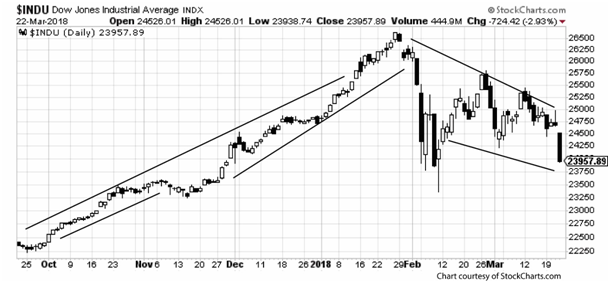

image.png


For the first four months shown on the chart, the channel was exceptionally narrow, and the price trend was remarkably consistent. Given that the value of the index is between 22,250 and 26,500 on this chart, the 500-point channel was remarkable over a four-month period.

The last two months presented a different story. The trading range was as high as 3,000 points and even when the early February volatility settled down, the bearish  channel narrowed only slightly, with recent trading range about 1,250 points.

The change in volatility is noteworthy – and visible. For those traders deeply concerned about the “end of the trend” and the unexpected explosion in volatility, it is worth remembering that volatility itself is cyclical, just like price direction. These big moves over 1,000 points over only a few days is unlikely to continue indefinitely. Volatility will calm down once the impact of recent news is absorbed. The president’s decision to impose tariffs on Chinese imports is deeply concerning to the markets, but this economic news tends to have only short-term impact on volatility.

The news dominates equally important economic news including reduced tax rates, improved employment news, and much more. We also cannot know the outcome of the possible tariff war. Since it benefits no one, it could be that tariffs will be canceled with a revised trade agreement, and that the long-term impact on the markets will be positive rather than negative.

The situation at the moment, in which depressed stock prices have caused panic and retreat from the market among many institutions and individuals, is a passing volatility trend. The unending tendency to “buy high and sell low” (instead of the other way around) repeats itself time again. For options traders who are aware of the evolving nature of historical volatility, when the markets are unsettled as they have been in recent weeks, this presents an exceptional trading opportunity.

Options traders who consider themselves hedger rather than speculators, and who act as contrarians, will be able to recognize the opportunity this market presents. High volatility is “bargain-hunting season” for options traders, based on the easily observed changes in historical volatility.


 

What Is SteadyOptions?

12 Years CAGR of 114.5%

Full Trading Plan

Complete Portfolio Approach

Real-time trade sharing: entry, exit, and adjustments

Diversified Options Strategies

Exclusive Community Forum

Steady And Consistent Gains

High Quality Education

Risk Management, Portfolio Size

Performance based on real fills

Subscribe to SteadyOptions now and experience the full power of options trading!
Subscribe

Non-directional Options Strategies

10-15 trade Ideas Per Month

Targets 5-7% Monthly Net Return

Visit our Education Center

Recent Articles

Articles

  • Delta-Neutral Options Strategies for Earnings

    Most options trading starts with a directional guess: you think a stock goes up, so you buy calls. But some of the most reliable earnings strategies don't require you to be right about direction at all. They're built to profit from volatility itself — from how much a stock moves, or from the collapse of implied volatility after the report — while staying largely indifferent to which way it goes.

    By krisbee,

    • 0 comments
    • 158 views
  • The Last 14 Minutes: Why We Stopped Looking at Options Closing Prices

    Here is a puzzle from our own earningsstudy charts. On Thursday, August 6, the ADBE one-week put calendar — the same 260 strike, the same September 11/18 expirations — was worth $1.425 at 3:46pm and $2.60 at the 4:00pm close. Nothing happened to the trade in those fourteen minutes.

    By krisbee,

    • 1 comment
    • 4547 views
  • Optimizing Portfolio Growth: Managing Capital and Liabilities in Modern Tax Planning

    Growing your investment portfolio involves more than just picking winners. While strong returns are the goal, many investors overlook a critical factor that significantly impacts their net worth: tax planning. Managing your capital and liabilities with taxes in mind isn't just about saving money in April. It's a year-round strategy that can accelerate your portfolio's growth and help you keep more of what you earn.

    By Kim,

    • 0 comments
    • 1295 views
  • Expanded Trading Hours for Select Equity Options

    The Cboe Options Exchange will start offering expanded trading hours for select high-liquidity single-stock equity options. The schedule features a morning Global Trading Hours (GTH) session from 7:30 a.m. to 9:25 a.m. ET and an afternoon Curb session from 4:00 p.m. to 4:15 p.m.

    By Kim,

    • 0 comments
    • 1012 views
  • How LEAPS Differ From Short-Term Options

    LEAPS stands for Long-Term Equity Anticipation Security. Which is just a long-dated option, typically referring to those with expirations more than a year out. There’s no technical difference between LEAPS and shorter-term options other than the expiration date. They’re traded on the same exchanges and have the same rules surrounding margin and whatnot.

    By Pat Crawley,

    • 0 comments
    • 31693 views
  • Why Not to Hold Strangles Through Earnings

    In my previous article, I described a strategy of buying a long strangle a few days before earnings and selling them just before earnings. In this article, I will show why it might be not a good idea to keep those strangles through earnings.

    By Kim,

    • 0 comments
    • 6388 views
  • Pre-Earnings Entry Price: What 31,000 Cycles Say

    Every card in the scanner carries a block called How expensive is this entry? It compares what you would pay today against what the same setup cost on the same ticker at the same point in past cycles. I built that block in August. It reads well. But a reading that looks sensible and a reading that predicts something are different things, and until last week I had only the first.


    By Romuald,

    • 3 comments
    • 972 views
  • Expensive Compared to What?

    A trader looks at a pre-earnings straddle and asks whether it is expensive. It is the right instinct and the wrong question, because the word carries no meaning on its own. Expensive against what? A $12 straddle on a $200 stock is not expensive or cheap. It is $12.

    By Romuald,

    • 0 comments
    • 788 views
  • Beyond Strategies: What Options Traders Should Know

    Options education almost always begins with structures. Traders learn vertical spreads, calendars, butterflies, condors, covered calls and straddles, study the expiration diagrams, work out maximum profit and loss, and build a sense of the conditions each structure is supposed to suit. That foundation is necessary and there is no way around it.

    By Kim,

    • 0 comments
    • 1562 views
  • SPX vs SPY Options: Which One Should You Trade? (2026 Guide)

    Both SPX and SPY options give you exposure to the S&P 500. They track the same 500 stocks, move nearly tick-for-tick, and offer the same core strategies — credit spreads, iron condors, butterflies, and 0DTE trades. Yet the two products settle differently, are taxed differently, and carry very different assignment risks.

    By krisbee,

    • 0 comments
    • 5783 views

  Report Article


We want to hear from you!


There are no comments to display.


Join the conversation

You can post now and register later. If you have an account, sign in now to post with your account.
Note: Your post will require moderator approval before it will be visible.

Guest
Add a comment...

×   Pasted as rich text.   Paste as plain text instead

  Only 75 emoji are allowed.

×   Your link has been automatically embedded.   Display as a link instead

×   Your previous content has been restored.   Clear editor

×   You cannot paste images directly. Upload or insert images from URL.

Loading...