

SteadyOptions is an options trading forum where you can find solutions from top options traders. Join Us!

We’ve all been there… researching options strategies and unable to find the answers we’re looking for. SteadyOptions has your solution.

Steady Futures 2021 Year In Review


Steady Futures launched in mid-2019 giving us approximately 2.5 years of performance data.  We look at our performance on an absolute basis based on a 50k portfolio size and a relative basis versus the SocGen Trend Index

Our 50k model portfolio trades options on various futures contracts.  We add and remove contracts periodically depending on liquidity and other factors.  We are always reviewing additional contracts for viability in our trading system to provide added diversification.  Signals are posted each week on Friday and the trades can be taken any time that day.  It is not important to try to match the fills we post.  Those following the system only need to get the direction right (long or short) and enter the trade at delta indicated by the system.  These are not time or price sensitive trades.  Members can take the trades at any time on the day the signals are updated.


In 2021, Steady Futures returned 21% versus 6.28% for our benchmark.  We consider this to be an exceptional year for the system, especially when we consider that we typically only have around 20% of our trading capital at risk at any given time.  Our system automatically adjusts the size of our trades for specific contracts based on the volatility of the underlying futures contract.

The system is very low maintenance and very easy to follow.
 

Here are the returns and win rate for the year by contract:
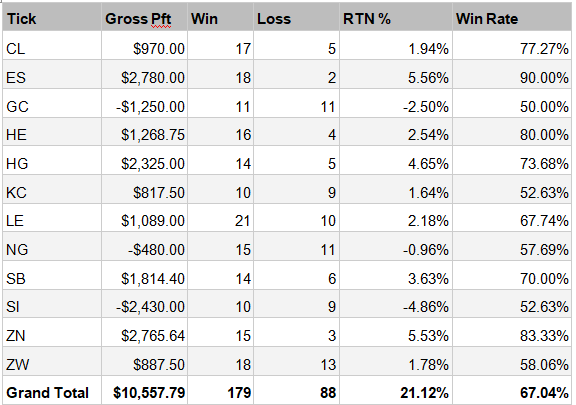
 

image.png


A note on win rate:  67% win rate may not seem impressive to some but this is very high for trend following systems.  Our win rate and overall performance were impacted by changes to system we made early in 2021. At the beginning of the year, we added a long term trend filter against the signal indicated by our system for a given contract.  If the long term filter signaled a trend in our system's direction we expressed that signal with a long spread. If the long term filter signaled a longer term trend against our signal or a neutral market we began using a short spread instead to allow us to benefit from decay in choppy markets.  We estimated this change would have improved 2020’s results somewhere in the range of 10%-15% and its impact was obvious in 2021.


Adjustments for 2022:

Beginning in 2022, we be increasing the size of the model portfolio to 100k.  There are fixed costs associated with trading futures options and this change will reduce those fixed costs as a percentage of overall trading costs for those using the system. 


Conclusion:

The Steady Futures trend following system had an exceptionally strong year.  The system continues to produce high signal accuracy and get us into big moves in the underlying futures contracts.  The changes made to take advantage of decay in choppy markets improved the system’s win rate but more importantly significantly reduced the number of outsized losses we experienced in 2020.  The system displays no (or even negative at times) correlation to equity markets and our recommendation is that any trader have some exposure to trend following in their portfolio. The increase in portfolio size will allow us to gain more from large moves in the underlying contracts and should facilitate continued strong performance from the system. 

Steady Futures is offered as a standalone subscription or part of various bundles

Read More:
Welcome to Steady Futures

 

What Is SteadyOptions?

12 Years CAGR of 114.5%

Full Trading Plan

Complete Portfolio Approach

Real-time trade sharing: entry, exit, and adjustments

Diversified Options Strategies

Exclusive Community Forum

Steady And Consistent Gains

High Quality Education

Risk Management, Portfolio Size

Performance based on real fills

Subscribe to SteadyOptions now and experience the full power of options trading!
Subscribe

Non-directional Options Strategies

10-15 trade Ideas Per Month

Targets 5-7% Monthly Net Return

Visit our Education Center

Recent Articles

Articles

  • Optimizing Portfolio Growth: Managing Capital and Liabilities in Modern Tax Planning

    Growing your investment portfolio involves more than just picking winners. While strong returns are the goal, many investors overlook a critical factor that significantly impacts their net worth: tax planning. Managing your capital and liabilities with taxes in mind isn't just about saving money in April. It's a year-round strategy that can accelerate your portfolio's growth and help you keep more of what you earn.

    By Kim,

    • 0 comments
    • 473 views
  • Expanded Trading Hours for Select Equity Options

    The Cboe Options Exchange will start offering expanded trading hours for select high-liquidity single-stock equity options. The schedule features a morning Global Trading Hours (GTH) session from 7:30 a.m. to 9:25 a.m. ET and an afternoon Curb session from 4:00 p.m. to 4:15 p.m.

    By Kim,

    • 0 comments
    • 612 views
  • How LEAPS Differ From Short-Term Options

    LEAPS stands for Long-Term Equity Anticipation Security. Which is just a long-dated option, typically referring to those with expirations more than a year out. There’s no technical difference between LEAPS and shorter-term options other than the expiration date. They’re traded on the same exchanges and have the same rules surrounding margin and whatnot.

    By Pat Crawley,

    • 0 comments
    • 31190 views
  • Why Not to Hold Strangles Through Earnings

    In my previous article, I described a strategy of buying a long strangle a few days before earnings and selling them just before earnings. In this article, I will show why it might be not a good idea to keep those strangles through earnings.

    By Kim,

    • 0 comments
    • 6090 views
  • Pre-Earnings Entry Price: What 31,000 Cycles Say

    Every card in the scanner carries a block called How expensive is this entry? It compares what you would pay today against what the same setup cost on the same ticker at the same point in past cycles. I built that block in August. It reads well. But a reading that looks sensible and a reading that predicts something are different things, and until last week I had only the first.


    By Romuald,

    • 3 comments
    • 655 views
  • Expensive Compared to What?

    A trader looks at a pre-earnings straddle and asks whether it is expensive. It is the right instinct and the wrong question, because the word carries no meaning on its own. Expensive against what? A $12 straddle on a $200 stock is not expensive or cheap. It is $12.

    By Romuald,

    • 0 comments
    • 542 views
  • Beyond Strategies: What Options Traders Should Know

    Options education almost always begins with structures. Traders learn vertical spreads, calendars, butterflies, condors, covered calls and straddles, study the expiration diagrams, work out maximum profit and loss, and build a sense of the conditions each structure is supposed to suit. That foundation is necessary and there is no way around it.

    By Kim,

    • 0 comments
    • 1073 views
  • SPX vs SPY Options: Which One Should You Trade? (2026 Guide)

    Both SPX and SPY options give you exposure to the S&P 500. They track the same 500 stocks, move nearly tick-for-tick, and offer the same core strategies — credit spreads, iron condors, butterflies, and 0DTE trades. Yet the two products settle differently, are taxed differently, and carry very different assignment risks.

    By krisbee,

    • 0 comments
    • 5158 views
  • Strike Price Effects Or Pinning Revisted

    Loyal readers of this blog will recall my post from 2019 “Pinning Down the ‘Option Pinning’”. If you have not heard of pinning have a look at that article as – spoiler – everything in it as well as Jeff Augen’s observations in his books which are referenced is still valid.

    By TrustyJules,

    • 0 comments
    • 2333 views
  • Could This Strategy Be The Holy Grail Of Investing?

    This is a reprint of my Seeking Alpha article from 2013. If you have SA subscription, you can read the full article including hundreds of comments here. For the record, the strategy implementation has changed since then, but the principle remains the same. You can read more here

    By Kim,

    • 6 comments
    • 5749 views

  Report Article


We want to hear from you!


When looking at performance numbers, it's worth to mention how conservative our performance reporting is. We report performance on the whole portfolio, while SF portfolio rarely has more than 20% of the trading capital at risk at any given time.

Example: with the model portfolio of $50k, the system typically allocates only 20% or $10k. With yearly gain of $10k, we would report 20% gain on the whole portfolio, while most other services would report 100% gain on the $10k capital at risk.

Share this comment


Link to comment
Share on other sites

Trend following systems typically have 35% win rates, so twice that is quite impressive if you still reap the benefits of trend following systems, of which the most important is very large wins compared to small loses. In other words, trend following works because, while it loses 2/3 of the time, loses are very controlled and wins are huge. Lots of people focus too much on win rate. To me, what matters are the annual returns of the capital at risk divided by the maximum drawdown, because that gives you an idea of how painful it is to stick to the plan, and how much to size your allocation to the strategy as it pertains to your overall portfolio volatility.

Share this comment


Link to comment
Share on other sites

I believe this is exactly the reason why they allocate only 20% of the account. The strategy can be volatile, and larger allocation can lead to larger drawdowns. Members with higher risk tolerance can of course increase the allocation - this will lead to higher returns and higher drawdowns.

Share this comment


Link to comment
Share on other sites

Can we get a how-to primer on how we analyze and action on the Friday SteadyFutures email ?


Share this comment


Link to comment
Share on other sites

6 hours ago, Bullfighter said:

Trend following systems typically have 35% win rates, so twice that is quite impressive if you still reap the benefits of trend following systems, of which the most important is very large wins compared to small loses. In other words, trend following works because, while it loses 2/3 of the time, loses are very controlled and wins are huge. Lots of people focus too much on win rate. To me, what matters are the annual returns of the capital at risk divided by the maximum drawdown, because that gives you an idea of how painful it is to stick to the plan, and how much to size your allocation to the strategy as it pertains to your overall portfolio volatility.

Yes we are concerned with the overall expectancy of the model and not the win rate.


There were pros and cons with incorporating spreads in the system.  The primary purpose was to make the model more accessible to average trader without have to trade far OTM contracts. Spreads can limit upside in some moves ( but we roll weekly) and also improved win rate in our case.


Most trend following systems ( from my experience) are traditionally long vol only and aren’t trading  spreads. 

Share this comment


Link to comment
Share on other sites

2 hours ago, PBJ said:

Can we get a how-to primer on how we analyze and action on the Friday SteadyFutures email ?


I will message you a link that explains taking the trades. 

Share this comment


Link to comment
Share on other sites


I've been considering adding commodities exposure to my portfolio and was planning to allocate $50k to Steady Futures this year, but see you're changing the model portfolio to $100k. Is it still within the realm of possibility to do a $50k allocation to this strategy or are the changes you're making going to make it difficult to follow for smaller than $100k allocations?

While I have extensive experience in options and stocks, my futures knowledge is a bit limited. I tracked a few markets for a while (e.g. CL, ES, GC, SB, ZW) and paper traded a modified version of the Turtle Traders strategy, but I'd consider myself a bit of a novice still.


Share this comment


Link to comment
Share on other sites

42 minutes ago, greenspan76 said:


I've been considering adding commodities exposure to my portfolio and was planning to allocate $50k to Steady Futures this year, but see you're changing the model portfolio to $100k. Is it still within the realm of possibility to do a $50k allocation to this strategy or are the changes you're making going to make it difficult to follow for smaller than $100k allocations?

While I have extensive experience in options and stocks, my futures knowledge is a bit limited. I tracked a few markets for a while (e.g. CL, ES, GC, SB, ZW) and paper traded a modified version of the Turtle Traders strategy, but I'd consider myself a bit of a novice still.


 No it will be easy to follow with 50k.  We will post the deltas for both 50k portfolio and 100k.  We did that this week.  You would just open a 50k delta spread and we will open one using the 100k delta.  
 

looks like this:  


image.png.512c9c82fa66cd27f4469c3703c9ea54.png


Share this comment


Link to comment
Share on other sites


Join the conversation

You can post now and register later. If you have an account, sign in now to post with your account.
Note: Your post will require moderator approval before it will be visible.

Guest
Add a comment...

×   Pasted as rich text.   Paste as plain text instead

  Only 75 emoji are allowed.

×   Your link has been automatically embedded.   Display as a link instead

×   Your previous content has been restored.   Clear editor

×   You cannot paste images directly. Upload or insert images from URL.

Loading...