

SteadyOptions is an options trading forum where you can find solutions from top options traders. Join Us!

We’ve all been there… researching options strategies and unable to find the answers we’re looking for. SteadyOptions has your solution.

Powerful Channel Signal – Combining Bollinger and T-line


Technicians tend to focus on single indicators, such as Bollinger Bands or the t-line. These are used to attempt to perfect a timing system. Individually, each signal has merit. Combined, the reversal signal is exceptionally strong.

To review: Bollinger Bands has three averages. The middle band is a 20-period simple moving average. The upper band and lower band are the second and third parts. Each are two standard deviations away from the middle band. This is a visual summary of historical volatility. Price generally is not likely to trade above the upper band or below the lower band for very long. When price does move outside of these ranges, it retreats back into range very quickly. So BB is like a “probability matrix” for timing entry and exit.


The T-line is an 8-day exponential moving average of price that yields surprisingly reliable signals for changes in price direction. The rule is that when price is above the t-line, it remains bullish until it crosses below and closes for at least two sessions. This sets up a bearish reversal. When price is below the t-line, the prevailing bearish trend continues until price crosses above and closes above for at least two consecutive sessions.


Taken apart, BB and the t-line are powerful on their own. However, when used in combination, you set up a very powerful dynamic trading range, making it easy to spot when a trend ends. As price advance, the BB upper band represents resistance and the t-line is support. When prices are moving down, the t-line is resistance and the BB lower band is support.


The chart for Cummins (CMI) shows the reversal signals this combination highlights.
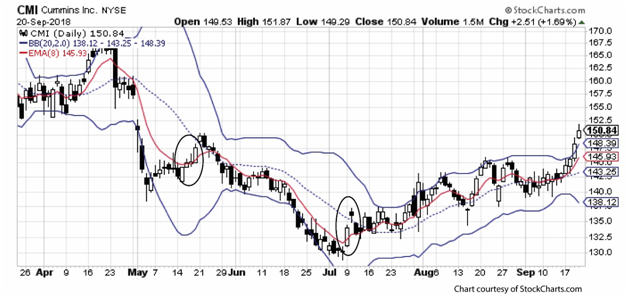
 

image.png


The combined signal sets up the narrow channel based on whether price trend is bullish or bearish. In a bullish trend, the upper Bollinger Band is rising resistance and the t-line (red on the chart) is rising support. The bullish trend continues until price crosses below the t-line and closes there for two consecutive sessions.


In a bearish trend, the t-line represents declining resistance and the lower Bollinger Band is declining support. The bearish trend continues until price crosses above the t-line and closes above for two consecutive sessions.


The CMI chart shows how this works. In May, price had been declining down to as low as $140 per share. But at mid-month, price crossed above the t-line (the red line), demonstrating that the downtrend, for the moment at least, was ending.


At the beginning of July, a further decline ended when price again moved across the t-line and marked the beginning of a gradual advance.


The combination of Bollinger Bands and t-line is so reliable that it can be used effectively in two ways. First, it distinguishes between retracement (not moving across the t-line) and reversal. Second, actual crossover is the signal point for leaving a current trade and taking profits, or for entering a new trend based on the newly revised price direction.


This solves the most disturbing aspect of short-term options trading. When do you enter and exit a trade? Even with the lack of clear reversal signals, the combined use of BB and the t-line is a powerful and reliable system to improve timing.

Michael C. Thomsett is a widely published author with over 80 business and investing books, including the best-selling Getting Started in Options, coming out in its 10th edition later this year. He also wrote the recently released The Mathematics of Options. Thomsett is a frequent speaker at trade shows and blogs on his website at Thomsett Guide as well as on Seeking Alpha, LinkedIn, Twitter and Facebook.

What Is SteadyOptions?

12 Years CAGR of 114.5%

Full Trading Plan

Complete Portfolio Approach

Real-time trade sharing: entry, exit, and adjustments

Diversified Options Strategies

Exclusive Community Forum

Steady And Consistent Gains

High Quality Education

Risk Management, Portfolio Size

Performance based on real fills

Subscribe to SteadyOptions now and experience the full power of options trading!
Subscribe

Non-directional Options Strategies

10-15 trade Ideas Per Month

Targets 5-7% Monthly Net Return

Visit our Education Center

Recent Articles

Articles

  • Is Bitcoin Worth Buying in 2026?

    If you want the answer to whether or not you should buy Bitcoin, you're in the right place! In recent years, the world has been introduced to an entirely new peer-to-peer currency that's made waves all over the globe. The cryptocurrency known as Bitcoin has been available since 2009, but it's been garnering worldwide attention ever since early 2018.

    By Kim,

    • 0 comments
    • 33 views
  • Cryptocurrency Red Flags: Staying Smart As A Newbie Investor

    It might not surprise you to find out that the world of cryptocurrency has quite a few red flags in it. It’s easy to make a mistake as a newbie trader to begin with, but that’s not where the issues end. From malicious actors to shady trading platforms, there’s a lot you need to be aware of to both protect your investments and your identity. 


    By Kim,

    • 0 comments
    • 44 views
  • From Wealth Building to Wealth Preserving: How to Diversify After You’ve Made It

    There's a time when the pursuit of success will change. Your hunger for growth in revenue, in scaling a company, or in stacking investments will begin to wane. You'll look at your account and see that you've crossed the line. At this point, you're no longer focused on proving to yourself that you can create wealth. Now you're thinking about making sure that wealth remains intact. This isn't a fear-based change; it's a maturity-based one. 

    By Kim,

    • 0 comments
    • 66 views
  • SteadyOptions 2025 Year in Review

    2025 marks our 14th year as a public trading service. We closed 83 winners out of 136 trades (61.0% winning ratio). Our model portfolio produced 6.5% compounded gain on the whole account based on 10% allocation per trade. 

    By Kim,

    • 0 comments
    • 1115 views
  • 10 Things That Will Make You a Better Trader

    Lots of people think that becoming a successful trader is about finding some secret formula that will ensure that they make all of the right decisions all the time, and never back the wrong horse. This is, of course, very unrealistic and untrue, but you know what?

    By Kim,

    • 0 comments
    • 1230 views
  • How To Reduce Investment Risks In 2026

    Studies show that over a third of US adults hope to explore additional income streams in 2026. Investing is an appealing option for people looking to boost their income and grow their money. There are always risks involved, but there are ways to increase your chances of success and avoid pitfalls.

    By Kim,

    • 0 comments
    • 1339 views
  • When Investors Lose Their Nerve

    It was a rough end to the week for markets, with a sharp sell-off on Friday reminding investors just how quickly sentiment can turn. For anyone who sold in late summer anticipating a correction and then bought back in at the start of October, that one-day drop might have felt like confirmation that they can’t win.

    By Kim,

    • 0 comments
    • 2394 views
  • Uncovering Common Cryptocurrency Trading Mistakes For Beginners

    Are you tempted by the shining allure of crypto trading? You aren’t alone. Decentralized cryptocurrencies hold perhaps the most tempting investment pull of a generation, especially amongst young or beginner investors. After all, by painting a different way to buy and sell, cryptocurrency offers something new that we’re all keen to get in on. 

    By Kim,

    • 0 comments
    • 9124 views
  • Buy Call, Sell Put Strategy Explained | SteadyOptions

    The Sell Put And Buy Call Strategy is an example of a synthetic stock options strategy: using call and puts options to mimic the performance of a position, usually involving the purchase of a stock. We saw this when looking at the synthetic covered call strategy elsewhere.

    By Chris Young,

    • 0 comments
    • 79247 views
  • Long Straddle Options Strategy | Maximize Profits with Big Moves

    Straddle Options Definition
    An options straddle strategy is buying (or selling) both a put and call option with the same strike price and expiration date for the same underlying asset, and paying both the put and call premiums.

    By Pat Crawley,

    • 0 comments
    • 83722 views

  Report Article


We want to hear from you!


There are no comments to display.


Join the conversation

You can post now and register later. If you have an account, sign in now to post with your account.
Note: Your post will require moderator approval before it will be visible.

Guest
Add a comment...

×   Pasted as rich text.   Paste as plain text instead

  Only 75 emoji are allowed.

×   Your link has been automatically embedded.   Display as a link instead

×   Your previous content has been restored.   Clear editor

×   You cannot paste images directly. Upload or insert images from URL.

Loading...