

SteadyOptions is an options trading forum where you can find solutions from top options traders. Join Us!

We’ve all been there… researching options strategies and unable to find the answers we’re looking for. SteadyOptions has your solution.

Buy the Winners: the Power of Momentum


Momentum is a phenomenon that tends to leave academics scratching their heads as it shouldn't really exist in a world of perfectly efficient markets.  Yet for 100 years a simple rules based, quantitative approach would have provided the opportunity to earn increased returns with reduced volatility and drawdowns vs. a buy and hold approach.

Buy the Winners


Eugene Fama, Father of the Efficient Market Hypothesis (EMH), has referred to momentum as "the premier market anomaly" which represents "the biggest embarrassment for Efficient Market Theory". And it's also very simple. So simple that it's under appreciated.
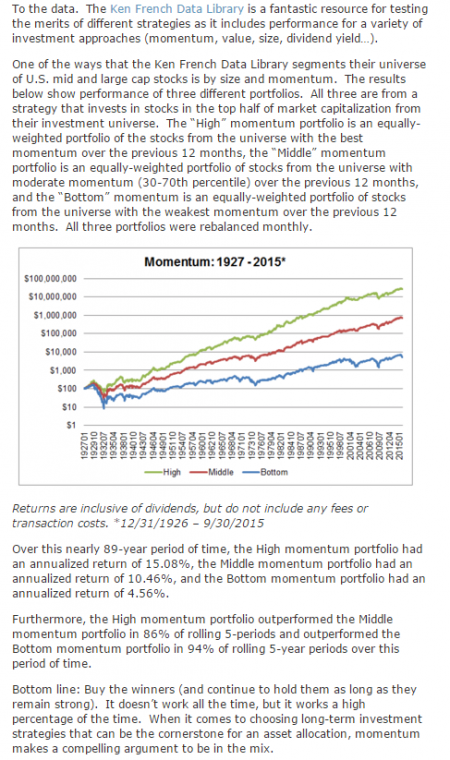
 

89 years of momentum.png

Source: http://systematicrelativestrength.com/2015/10/26/buy-winners-2/


In 1937 Cowles and Jones shared their findings that “taking one year as the unit of measurement for the period 1920 to 1935, the tendency is very pronounced for stocks which have exceeded the median in one year to exceed it also in the year following.”
 
The key here is that it doesn't work 100% of the time. Listen to Jim O'Shaughnessy discuss this here. Jim was comfortable writing "What Works on Wall Street" because he knew the tendency of humans to abandon strategies as soon as they went through a drawdown or period of relative underperformance. Human nature is unlikely to change, and this is a key belief to why simple strategies can continue to persist in a world of competitive markets. Since nothing works (meaning always producing profits and/or outperforming a benchmark) 100% of the time, the weak hands will eventually drop out. 
 
This is why I believe in combining together a few simple strategies where you have done a high degree of due diligence, and then follow them faithfully. When the next strategy of the month is in favor, you treat it with a high degree of caution and skepticism before even considering adjusting your plan. We all want to believe that the perfect strategy is out there that we just haven't found yet. I found it interesting as I read Ben Carlson's book that the largest Ponzi Scheme in history, run by Bernie Madoff, did not promise investors excessively high returns. It promised very good returns, but with almost no risk. Bernie was not stupid, he knew very well that humans desperately want to believe in the idea of making very good returns with little or no risk. From Ben's book:
 
"The beauty in Madoff's scam was the fact that he never promised home runs to his investors. Over an 18-year period, Madoff claimed to offer 10.6 percent annual returns to his investors, fairly similar to historical stock market gains. But the annualized volatility was under 2.5 percent, a fraction of the variability seen in the stock market, or the bond market for that matter. And what do investors want more than anything? If you answered a stock market return profile minus the stock market risk profile, you answered correctly. Investors want to believe this is possible."
 
Michael Covel had a discussion around this topic with Ewan Kirk of Cantab Capital during one of Michael's Trend Following podcasts.
 

I'm going to paraphrase about a five minute clip of the podcast which can be heard here. I highly recommend it.


The podcast


Covel: Losses are statistically inevitable.  There are still a number of people out there, some astute and some not, that still don’t want to imagine losses as a part of the game.


Kirk: Yep, people are desperate to invest in something that never loses money.  And that, of course, is why Bernard Madoff existed.  Everyone is desperate to invest in something that never loses money. I’d like to invest in something which never loses money.  I’d love to come up with a strategy that never loses money. Of course, we all want that.


The reality is that maybe the best you can look for over a long period such as 20 or 30 years is a Sharpe ratio of .8, .9, maybe 1. 


Take a simulation of a 20% volatility with a 20% return per year. Every 2 years you will have a drawdown of 15% statistically, and a 20% drawdown every 4 years. And you don’t have to run very many simulations before you get a 40% drawdown that can last five years.  Remember, this (simulation) is something that is guaranteed to make 20% per annum over a long enough period of time.  The expectation of losses should be something everyone should build into their investment process at all times.


Summary


The enemy of a good plan is the dream of a perfect plan.  Drawdowns and losses are part of the game but your human nature of survival will put up a fight against rationality when drawdowns occur.  The human brain is capable of incredible optimism as well as pessimism.  Be aware of it, and have expectations that are statistically valid.  Not just past performance.


Jesse Blom is a licensed investment advisor and Vice President of Lorintine Capital, LP. He provides investment advice to clients all over the United States and around the world. Jesse has been in financial services since 2008 achieving multiple industry achievements including qualifying membership in the Million Dollar Round Table for 5 consecutive years. Membership in this prestigious group represents the top 1% of financial professionals in the world. Jesse has a Bachelor of Science in Finance from Oral Roberts University.
Jesse is managing the LC Diversified portfolio.

What Is SteadyOptions?

12 Years CAGR of 114.5%

Full Trading Plan

Complete Portfolio Approach

Real-time trade sharing: entry, exit, and adjustments

Diversified Options Strategies

Exclusive Community Forum

Steady And Consistent Gains

High Quality Education

Risk Management, Portfolio Size

Performance based on real fills

Subscribe to SteadyOptions now and experience the full power of options trading!
Subscribe

Non-directional Options Strategies

10-15 trade Ideas Per Month

Targets 5-7% Monthly Net Return

Visit our Education Center

Recent Articles

Articles

  • Is Bitcoin Worth Buying in 2026?

    If you want the answer to whether or not you should buy Bitcoin, you're in the right place! In recent years, the world has been introduced to an entirely new peer-to-peer currency that's made waves all over the globe. The cryptocurrency known as Bitcoin has been available since 2009, but it's been garnering worldwide attention ever since early 2018.

    By Kim,

    • 0 comments
    • 279 views
  • Cryptocurrency Red Flags: Staying Smart As A Newbie Investor

    It might not surprise you to find out that the world of cryptocurrency has quite a few red flags in it. It’s easy to make a mistake as a newbie trader to begin with, but that’s not where the issues end. From malicious actors to shady trading platforms, there’s a lot you need to be aware of to both protect your investments and your identity. 


    By Kim,

    • 0 comments
    • 245 views
  • From Wealth Building to Wealth Preserving: How to Diversify After You’ve Made It

    There's a time when the pursuit of success will change. Your hunger for growth in revenue, in scaling a company, or in stacking investments will begin to wane. You'll look at your account and see that you've crossed the line. At this point, you're no longer focused on proving to yourself that you can create wealth. Now you're thinking about making sure that wealth remains intact. This isn't a fear-based change; it's a maturity-based one. 

    By Kim,

    • 0 comments
    • 316 views
  • SteadyOptions 2025 Year in Review

    2025 marks our 14th year as a public trading service. We closed 83 winners out of 136 trades (61.0% winning ratio). Our model portfolio produced 6.5% compounded gain on the whole account based on 10% allocation per trade. 

    By Kim,

    • 0 comments
    • 1234 views
  • 10 Things That Will Make You a Better Trader

    Lots of people think that becoming a successful trader is about finding some secret formula that will ensure that they make all of the right decisions all the time, and never back the wrong horse. This is, of course, very unrealistic and untrue, but you know what?

    By Kim,

    • 0 comments
    • 2815 views
  • How To Reduce Investment Risks In 2026

    Studies show that over a third of US adults hope to explore additional income streams in 2026. Investing is an appealing option for people looking to boost their income and grow their money. There are always risks involved, but there are ways to increase your chances of success and avoid pitfalls.

    By Kim,

    • 0 comments
    • 1447 views
  • When Investors Lose Their Nerve

    It was a rough end to the week for markets, with a sharp sell-off on Friday reminding investors just how quickly sentiment can turn. For anyone who sold in late summer anticipating a correction and then bought back in at the start of October, that one-day drop might have felt like confirmation that they can’t win.

    By Kim,

    • 0 comments
    • 2465 views
  • Uncovering Common Cryptocurrency Trading Mistakes For Beginners

    Are you tempted by the shining allure of crypto trading? You aren’t alone. Decentralized cryptocurrencies hold perhaps the most tempting investment pull of a generation, especially amongst young or beginner investors. After all, by painting a different way to buy and sell, cryptocurrency offers something new that we’re all keen to get in on. 

    By Kim,

    • 0 comments
    • 9218 views
  • Buy Call, Sell Put Strategy Explained | SteadyOptions

    The Sell Put And Buy Call Strategy is an example of a synthetic stock options strategy: using call and puts options to mimic the performance of a position, usually involving the purchase of a stock. We saw this when looking at the synthetic covered call strategy elsewhere.

    By Chris Young,

    • 0 comments
    • 79688 views
  • Long Straddle Options Strategy | Maximize Profits with Big Moves

    Straddle Options Definition
    An options straddle strategy is buying (or selling) both a put and call option with the same strike price and expiration date for the same underlying asset, and paying both the put and call premiums.

    By Pat Crawley,

    • 0 comments
    • 84901 views

  • Like 1
  Report Article


We want to hear from you!


@Jesse I think I'll hang that one on my wall and and make it my morning mantra before I start trading!

"The enemy of a good plan is the dream of a perfect plan."

Share this comment


Link to comment
Share on other sites


Join the conversation

You can post now and register later. If you have an account, sign in now to post with your account.
Note: Your post will require moderator approval before it will be visible.

Guest
Add a comment...

×   Pasted as rich text.   Paste as plain text instead

  Only 75 emoji are allowed.

×   Your link has been automatically embedded.   Display as a link instead

×   Your previous content has been restored.   Clear editor

×   You cannot paste images directly. Upload or insert images from URL.

Loading...