

The theory states that stock prices are unpredictable and move in a manner that cannot be predicted. It is closely associated with the efficient market hypothesis (EMH), which states that the market efficiently and immediately discounts prices for information about a company.
EMH refers only to how stock prices act efficiently in managing information. However, this theory does not claim that markets behave efficiently. Anyone who has trade din stocks and options knows how inefficient the market does behave. The glaring flaw in EMH is that it discounts all information efficiently, including true information as well as rumors and gossip. EMH itself is a flawed theory, and because RWH is based on a false assumption of broader efficiency, it also is flawed.
The major publications about RWH have been written by professors (Cootner, Kendall, Malkiel, and Fama). [1]
Curiously, few real-world practical books claim validity to RWH and active traders tend to believe in the power of technical and fundamental analysis as predictive tools, rejecting the gloomy and pessimistic ideas underlying RWH. An options trader, for example, who would adopt RWH as a means for selecting traders, would recognize that trading puts or calls is a 50/50 proposition. Few if any options people would accept this suggestion. The focus on implied volatility, technical analysis and often elaborate options strategies, all are based on the belief that markets can be predicted.
For example, consider how stock prices behave after an earnings surprise. A big spike upward follows a positive surprise, or downward after a negative surprise. Prices tend to correct very quickly after these over-reactions to the news. This is neither efficient nor random. It is predictable and can be acted upon with high confidence. Rather than assuming it is all random, options traders tend to experience better results when acting as contrarians. When most traders react emotionally, contrarians are coldly logical and recognize opportunities. Contrarian trading involves timing, not acceptance of random events.
If the markets truly were random, prices of any stock would tend to remain in a narrow trading range. Half the time, price would advance, and the other half of the time prices would decline. More typically, markets tend to move with the overall markets. A study of alpha (tendency of stock prices to mirror prices of an index) prove this. Over time, markets have risen and continue to rise. Since November, 2016 (the day after the last presidential election) the DJIA advanced from 18,000 to 25,000, a 39% change. If markets were random, you would expect to see to substantial change in either an index like the DJIA or any individual stock.
In other words, RWH is easily disproven.
Countering RWH, a non-random walk hypothesis has evolved in recent years, pointing out that prices develop in trends, either rising or falling over the long term. A study of the markets supports this contention (see publications of Weber, Lo &MacKinlay and Bhargava). [2]
Lo, Andrew W.; Mackinlay, Archie Craig (2002). A Non-Random Walk Down Wall Street (5th ed.). Princeton University Press. pp. 4–47
Bhargava, A. (2014) Firms' fundamentals, macroeconomic variables and quarterly stock prices in the US. Journal of Econometrics, 183, 241-250
Ever since prices have been tracked on listed stocks, trends have been set and develop predictably. The Dow Theory (developed based on publications of Charles Dow) promotes the concept of trends and confirmation. An analysis of two separate index trends proves that they confirm one another. The DJIA for the past three years reveals a strong bullish trend, as shown in its 3-year chart.
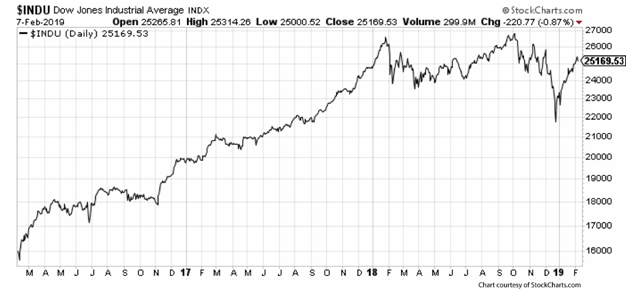
Compare this to the Dow Jones Transportation Average for the same 3-year period:
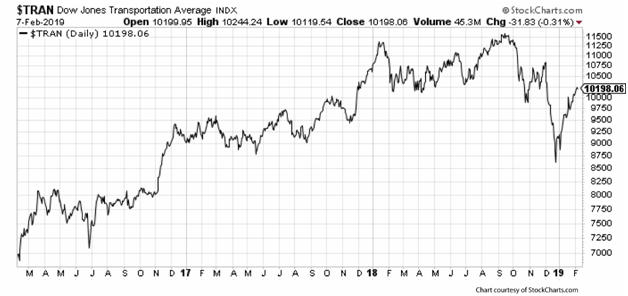
The two charts are practically identical. The two averages (industrials and transportations) consist of entirely different collections of stock. If market behavior were truly random, these would not advance, and they would not mirror one another. These two charts prove the Dow Theory claim that averages confirm one another; it also shatters the belief that market prices are random. A truly random chart would move within a narrow range, and the two separate averages would not be identical.
For options traders, the rejection of RWH (and EMH) are encouraging. The belief in these systems makes options trading pointless and a losing battle, as it does about investing in stocks and any other security. However, the belief in technical analysis and trends provides many predictive elements that options traders can use to improve their trading experience. For example, making trades right after earnings surprises in anticipation of exaggerated price movement about to reverse, is a method for exploiting price and volume spikes, gaps, and candlestick signals as they develop. All of these technical signals have proven to serve as reliable indicators in options trading, notably as part of a swing trading strategy.
The academic theories of the market may be comforting to professors and their students. However, once students graduate and advance into the real world, the harsh realities of the market quickly replace the comforting but inaccurate theories promoted in the world where practical application has no place.
Michael C. Thomsett is a widely published author with over 80 business and investing books, including the best-selling Getting Started in Options, coming out in its 10th edition later this year. He also wrote the recently released The Mathematics of Options. Thomsett is a frequent speaker at trade shows and blogs on his website at Thomsett Guide as well as on Seeking Alpha, LinkedIn, Twitter and Facebook.
[1]Cootner, Paul H. (1964).The Random Character of Stock Market Prices. MIT Press.
Malkiel, Burton G. (1973).A Random Walk Down Wall Street, 6th ed. W.W. Norton & Company.
Fama, Eugene F.(September–October 1965). “Random Walks in Stock Market Prices.” Financial Analysts Journal 21(5): 55–59.
Kendall, M.G. & Hill, Bradford A. (1953). "The Analysis of Economic Time-Series-Part I: Prices." Blackwell Publishing 116(1): 11–34
[2]Lo, Andrew W.; Mackinlay, Archie Craig (2002). A Non-Random Walk Down Wall Street, 5th ed. Princeton University Press, pp. 4–47
Bhargava, A. (2014).“Firms' fundamentals, macroeconomic variables and quarterly stock prices in the US.” Journal of Econometrics 183, pp. 241-250




There are no comments to display.
Join the conversation
You can post now and register later. If you have an account, sign in now to post with your account.
Note: Your post will require moderator approval before it will be visible.