

SteadyOptions is an options trading forum where you can find solutions from top options traders. Join Us!

We’ve all been there… researching options strategies and unable to find the answers we’re looking for. SteadyOptions has your solution.

Options Trading Matrix


One of the greatest benefits to trading options is that you can make money in an up, down, or sideways market. For example: In a bull market you can buy calls, or purchase bull call spreads and bull risk reversals. In a bear market you can profit buying puts, bear put spreads and selling bear call spreads.

And in sideways markets you can make money selling straddles, strangles and iron condors.


And there are many more strategies to make money in any market. Below is my Options Trading Matrix which breaks these strategies into Bullish, Bearish, Long Volatility and Short Volatility categories.
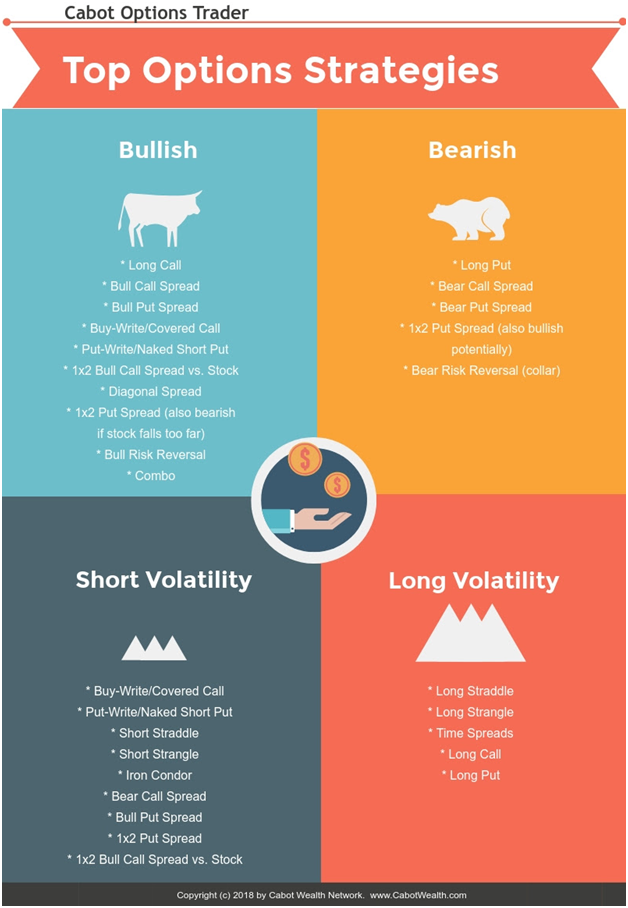
options trading matrix

For beginner options traders I recommend sticking to three core strategies that can make money in any market condition. These are buying calls in a bull market, buying puts in a bear market and selling volatility via a buy-write/covered call.


Here is the breakdown on buying Calls:


A call purchase is used when a rise in the price of the underlying asset is expected. This strategy is the purchase of a call at a specific strike price with unlimited potential for profits. The maximum loss on this trade is the amount of premium paid. 


For example, the purchase of the XYZ 100 strike call for $1 would only risk the $1 paid. If the stock were to close at $100 or below at expiration, that call purchase would be worthless. If the stock were to go above $101, the holder of this call would make $100 per contract purchased per point above $101.
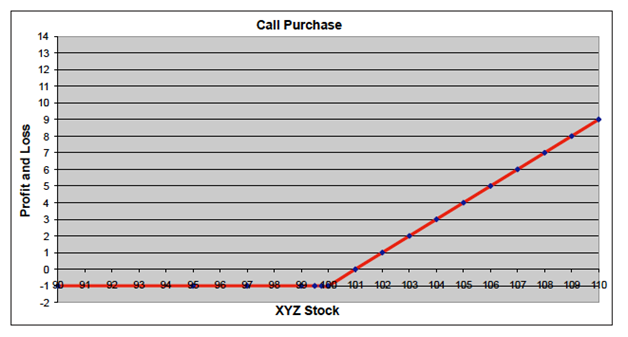
 

image.png


For the immediate level options trader buying calls, buying puts and buy-write/covered calls should also be used, along with bull call spreads, bull put spreads, bear call spreads, bear put spreads, put-writes and iron condors.


Here is my breakdown of an Iron Condor:


The Iron Condor position is the combination of a bear call spread and a bull put spread in the same underlying. 


It’s a strategy that’s a high probability trade, allowing for a modest profit with enough room for error. Also, it’s meant to be a directionally neutral trade, used when volatility is elevated in relation to its forecasted range. 


It’s my favorite volatility selling strategy. By selling a call spread and a put spread, you gain extra short volatility and decay, while at the same time limiting your risk.


Here’s the hypothetical call spread:


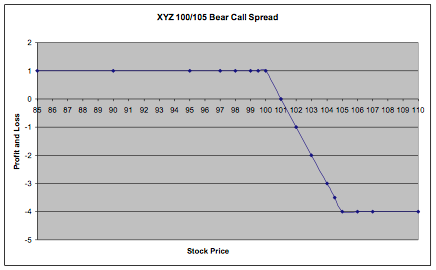
Stock XYZ is trading at 90. You’d theoretically sell the 100/105 bear call spread for $1. To execute this trade, you would:


  • Sell the 100 calls 
  • Buy the 105 calls

For a total credit of $1.
 

Here is the graph of this trade at expiration.
bear call spread


Here’s the hypothetical put spread:


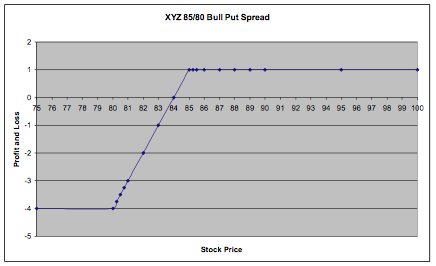
Stock XYZ is trading at 90. You’d sell the 85/80 put spread for $1. To execute this trade you would:

  • Sell the 85 Puts
  • Buy the 80 Puts

For a total credit of $1. 
 

Here is the graph of this trade at expiration:
put spread
 

Now we will combine these two spreads to make an Iron Condor:


To do this, you simultaneously:

  • Sell the 100 calls 
  • Buy the 105 calls

For a total credit of $1.
 

And

  • Sell the 85 Puts
  • Buy the 80 Puts

For a total credit of $1.
 

This would give you a total credit of $2. 


Here is the graph of this trade at expiration:
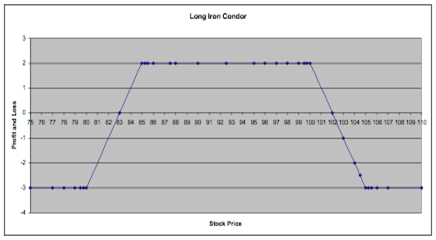
Iron Condor
 

As you can see in the chart, at expiration, you’d make $2 as long as the stock stays between 85 and 100. Meanwhile, your downside is limited to $3 if the stock goes lower than 80 or higher than 105. 


And for the professional trader, every strategy listed in the options strategy matrix above can be used to profit in any market conditions.


To learn more about these strategies and Cabot Options Trader where I use these strategies to create profits in any market visit Jacob Mintz or optionsace.com where I teach and mentor options traders.


Your guide to successful options trading,


Jacob Mintz

What Is SteadyOptions?

12 Years CAGR of 114.5%

Full Trading Plan

Complete Portfolio Approach

Real-time trade sharing: entry, exit, and adjustments

Diversified Options Strategies

Exclusive Community Forum

Steady And Consistent Gains

High Quality Education

Risk Management, Portfolio Size

Performance based on real fills

Subscribe to SteadyOptions now and experience the full power of options trading!
Subscribe

Non-directional Options Strategies

10-15 trade Ideas Per Month

Targets 5-7% Monthly Net Return

Visit our Education Center

Recent Articles

Articles

  • Optimizing Portfolio Growth: Managing Capital and Liabilities in Modern Tax Planning

    Growing your investment portfolio involves more than just picking winners. While strong returns are the goal, many investors overlook a critical factor that significantly impacts their net worth: tax planning. Managing your capital and liabilities with taxes in mind isn't just about saving money in April. It's a year-round strategy that can accelerate your portfolio's growth and help you keep more of what you earn.

    By Kim,

    • 0 comments
    • 535 views
  • Expanded Trading Hours for Select Equity Options

    The Cboe Options Exchange will start offering expanded trading hours for select high-liquidity single-stock equity options. The schedule features a morning Global Trading Hours (GTH) session from 7:30 a.m. to 9:25 a.m. ET and an afternoon Curb session from 4:00 p.m. to 4:15 p.m.

    By Kim,

    • 0 comments
    • 627 views
  • How LEAPS Differ From Short-Term Options

    LEAPS stands for Long-Term Equity Anticipation Security. Which is just a long-dated option, typically referring to those with expirations more than a year out. There’s no technical difference between LEAPS and shorter-term options other than the expiration date. They’re traded on the same exchanges and have the same rules surrounding margin and whatnot.

    By Pat Crawley,

    • 0 comments
    • 31205 views
  • Why Not to Hold Strangles Through Earnings

    In my previous article, I described a strategy of buying a long strangle a few days before earnings and selling them just before earnings. In this article, I will show why it might be not a good idea to keep those strangles through earnings.

    By Kim,

    • 0 comments
    • 6093 views
  • Pre-Earnings Entry Price: What 31,000 Cycles Say

    Every card in the scanner carries a block called How expensive is this entry? It compares what you would pay today against what the same setup cost on the same ticker at the same point in past cycles. I built that block in August. It reads well. But a reading that looks sensible and a reading that predicts something are different things, and until last week I had only the first.


    By Romuald,

    • 3 comments
    • 672 views
  • Expensive Compared to What?

    A trader looks at a pre-earnings straddle and asks whether it is expensive. It is the right instinct and the wrong question, because the word carries no meaning on its own. Expensive against what? A $12 straddle on a $200 stock is not expensive or cheap. It is $12.

    By Romuald,

    • 0 comments
    • 550 views
  • Beyond Strategies: What Options Traders Should Know

    Options education almost always begins with structures. Traders learn vertical spreads, calendars, butterflies, condors, covered calls and straddles, study the expiration diagrams, work out maximum profit and loss, and build a sense of the conditions each structure is supposed to suit. That foundation is necessary and there is no way around it.

    By Kim,

    • 0 comments
    • 1085 views
  • SPX vs SPY Options: Which One Should You Trade? (2026 Guide)

    Both SPX and SPY options give you exposure to the S&P 500. They track the same 500 stocks, move nearly tick-for-tick, and offer the same core strategies — credit spreads, iron condors, butterflies, and 0DTE trades. Yet the two products settle differently, are taxed differently, and carry very different assignment risks.

    By krisbee,

    • 0 comments
    • 5195 views
  • Strike Price Effects Or Pinning Revisted

    Loyal readers of this blog will recall my post from 2019 “Pinning Down the ‘Option Pinning’”. If you have not heard of pinning have a look at that article as – spoiler – everything in it as well as Jeff Augen’s observations in his books which are referenced is still valid.

    By TrustyJules,

    • 0 comments
    • 2344 views
  • Could This Strategy Be The Holy Grail Of Investing?

    This is a reprint of my Seeking Alpha article from 2013. If you have SA subscription, you can read the full article including hundreds of comments here. For the record, the strategy implementation has changed since then, but the principle remains the same. You can read more here

    By Kim,

    • 6 comments
    • 5764 views

  Report Article


We want to hear from you!


There are no comments to display.


Join the conversation

You can post now and register later. If you have an account, sign in now to post with your account.
Note: Your post will require moderator approval before it will be visible.

Guest
Add a comment...

×   Pasted as rich text.   Paste as plain text instead

  Only 75 emoji are allowed.

×   Your link has been automatically embedded.   Display as a link instead

×   Your previous content has been restored.   Clear editor

×   You cannot paste images directly. Upload or insert images from URL.

Loading...