
Leaderboard




Popular Content
Showing content with the highest reputation since 09/24/26 in Posts
-
Doing pretty well with calendar screener on this tool. This week I am up: V calendar up 30% BA calendar up 24% Looks like that has also been the most winning trades based on the earnings study data: https://i.imgur.com/FXSlvG2.png2 points
-
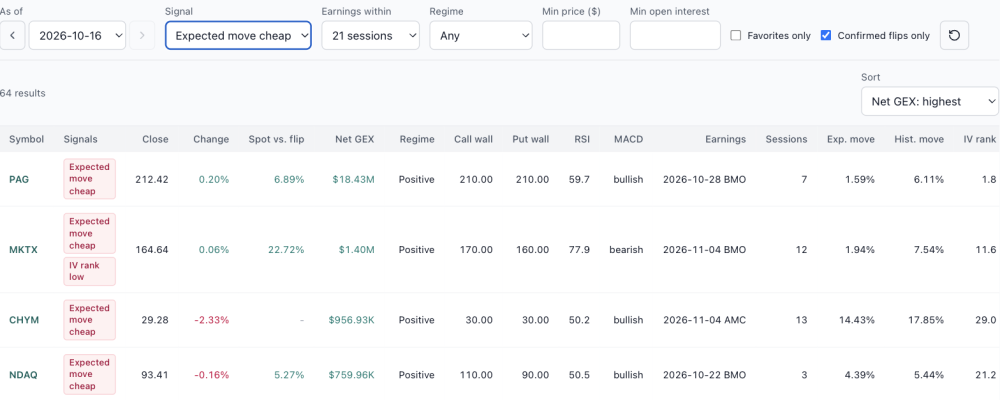
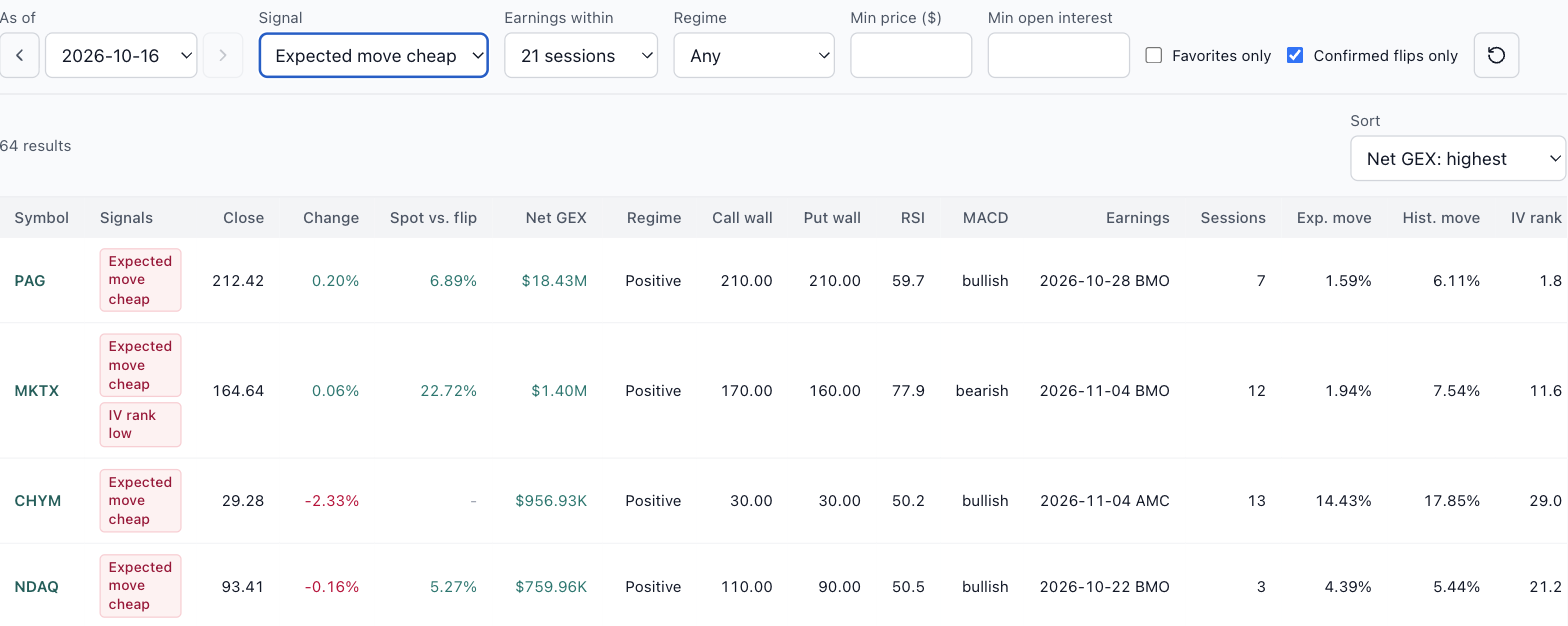
Coming soon: Market Structure, a nightly scan of every optionable stock The GEX page answers questions about one symbol at a time. The next release, Market Structure, asks the same questions of every optionable stock at once, every evening, from EOD data. It isn't open yet, but it's far enough along that I want to show you what it does and hear what you'd want from it. On Oct 16's data it scanned 5,991 symbols and counted what stood out, in three groups: Positioning: stocks whose net gamma flipped positive or negative, plus call wall and put wall moves. Momentum: RSI overbought and oversold, MACD crosses, and Bollinger Band squeezes and breaks. Earnings pricing: expected moves priced richer or cheaper than the stock's own history, reports the options haven't priced in yet, and IV rank high or low. Market Structure preview, EOD Oct 16. Each count opens the list behind it. Here's the one I expect earnings traders to use most: expected move cheap, for stocks reporting within the next 21 sessions. It found 64. Compare the Exp. move column (what the options price in for the report) with Hist. move (what the stock actually did in past cycles). NDAQ, reporting Oct 22, priced 4.39% against a 5.44% history. CHYM priced 14.43% against 17.85%. These are examples, not picks. Expected move cheap, earnings within 21 sessions, EOD Oct 16. A scan like this needs judgment as well as signals. PAG shows 1.59% priced against 6.11% historical. A gap that large usually means thin options rather than a bargain, which is why the list has minimum price and open interest filters, and why you'd still check the spread cost on the Summary page before believing it. I'm finishing it now and will post here when it opens. If there's a signal you'd want in the scan, send it through the Ask button in the top bar while it's still easy to add. Educational research only, not trade advice.

 2 points
 -
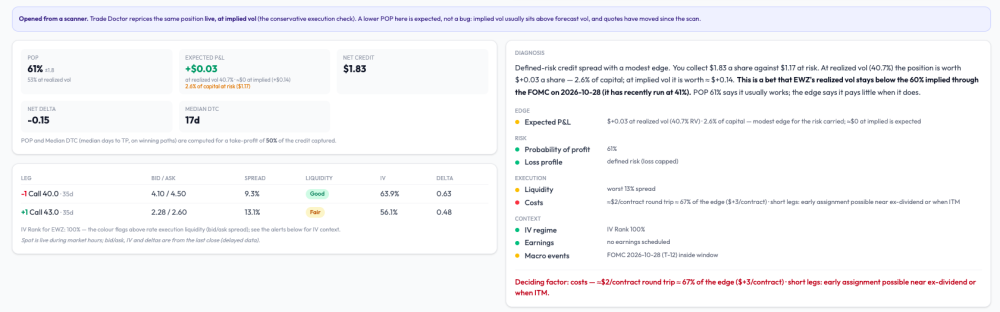
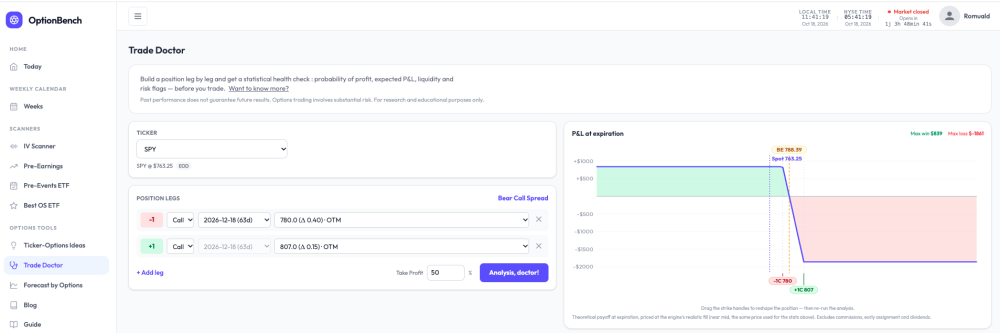
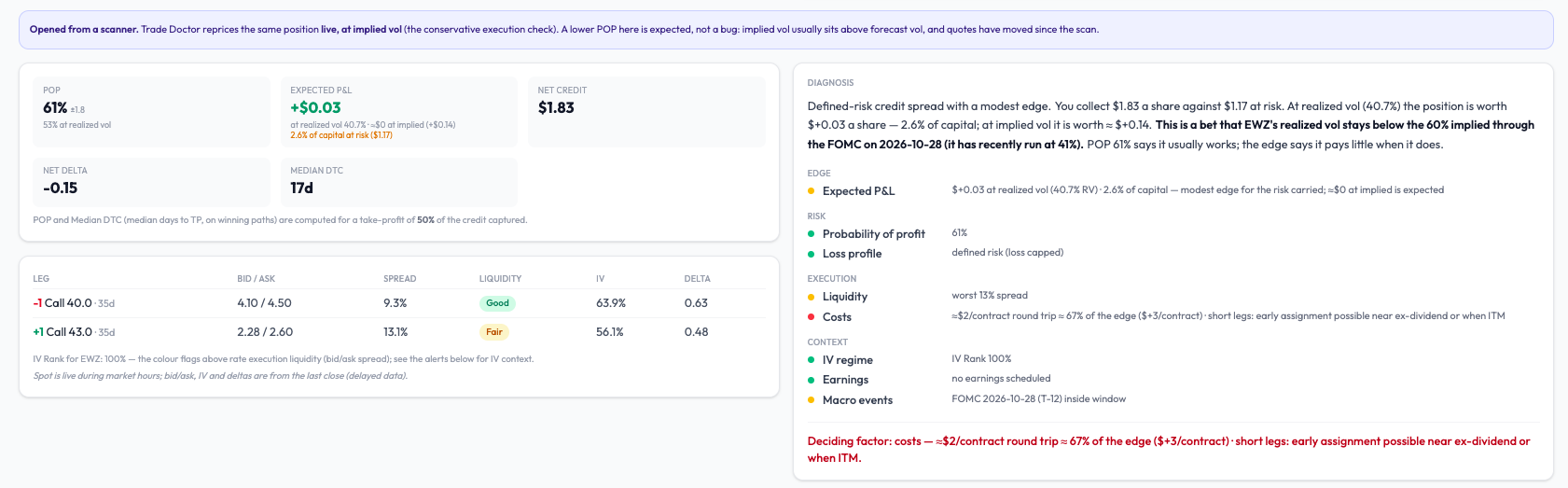
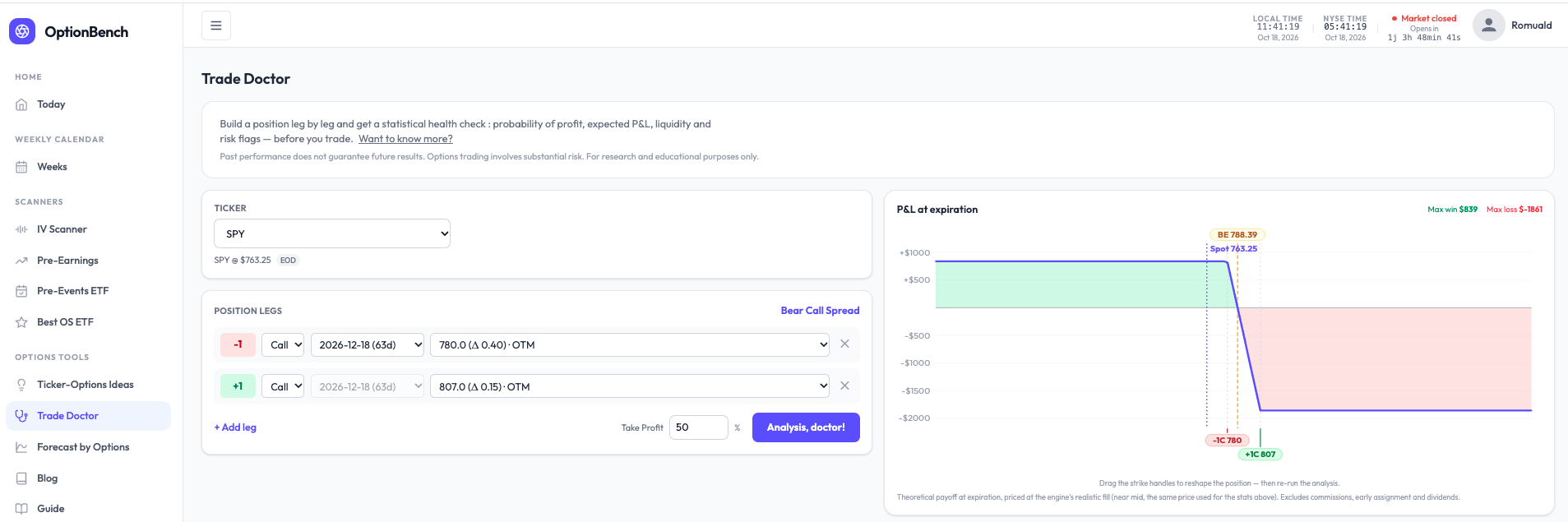
What are you actually betting on? A small change to how Trade Doctor reads a position. Every options tool shows a POP. Almost none tells you what the bet is. A bear call spread on SPY with POP 81% reads like a good trade — until you ask what has to be true for it to pay, and what it pays when it does. I rebuilt the diagnosis block of OptionBench’s Trade Doctor around that question. It now opens with a plain-language reading, computed, not written by a model. For that SPY spread (−780/+807 calls, Dec 18): Defined-risk credit spread with a modest edge. You collect $8.39 a share against $18.61 at risk. At realized vol (10.1%) the position is worth +$0.69 a share — 3.7% of capital; at implied vol it is worth ≈ $0. This is a bet that SPY’s realized vol stays below the 12% implied through the FOMC on Oct 28 (it has recently run at 10%). POP 81% says it usually works; the edge says it pays little when it does. Then four questions — edge, risk, execution, context — one finding per line, one number per finding, all in the same convention. And one last line naming what weighs most: Deciding factor: the edge — +$0.69 a share at realized vol, 3.7% of capital. A rise in realized vol toward implied erases it. No verdict. The tool doesn’t say take it or pass. It says what the bet is, where it’s thin, and what would break it — the three things you need to decide for yourself, in the order you need them. On an EWZ spread it wrote “Deciding factor: costs — a $3/contract edge against ≈$2 of commissions; little is left after the broker.” That sentence has saved a few of us from a few trades. The point isn’t the SPY spread. It’s that “81% POP” and “pays little when it works” are both true of the same position, and most screens only show you the first one. Romuald - OptionBench
 2 points
 -
We are doing another round of research on traders' views around psychology. The survey is now live: https://www.surveymonkey.com/r/steadyoptions2 points
-
Not sure if it helps to community but Schwab and ThinkOrSwim seems to be experiencing outages of completely not letting users login nor do transactions once logged in (website seems to allow login). Seems to be consistent with DownDetector dot com reports...2 points
-
Thanks for the demonstration, @krisbee. The Earnings Study tool is becoming quite feature-rich. The narration above will be quite helpful, especially to newcomers to SO who haven't had the benefit of being part of the years of forum dialog that have led to the creation of the various SO strategies and the tool itself. The Median return matrix is helpful, but the the "Reached Target" option adds a dimension that I find very useful, since it allows me to examine potential quicker in-out trades with a possibly lower target. I'm also looking forward to using the spread builder/modeler you mentioned. Keep it up.1 point
-
Thank you, and that’s a fair ask. Two things on it. Self-reported results are the wrong instrument for a win rate: people report wins more readily than losses, and twenty fills from five people can’t move a figure built on hundreds of cycles. What subscriber fills can teach, and what the backtest can’t, is execution: the gap between the card’s mid ±0.5% and what the market actually gave. That gap is the whole game on thin names (LEVI two weeks ago), and it is invisible from the data side. So here’s what I’d suggest instead: post your fills here (ticker, structure, entry date and debit, exit date and credit) and I’ll line each one up against what the card assumed on that day. Over a quarter that gives us something no backtest has: a measured slippage per name. The win rate itself I’ll keep measuring the only way that holds up, on the full history, and publishing with the sample size next to it.1 point
-
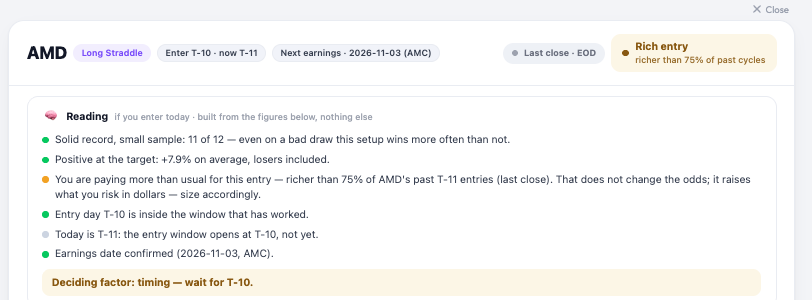
“Reload cheapness” was pricing the first eight tiles of the map and stopping there: each tile is a live chain fetch, so the cap was deliberate, but nothing on the page said so, and a blank tile reads as “no data”. As of today it prices every pre-earnings tile, three at a time, with a counter so you can see it working. Until ~9:45 ET it’s Friday’s close for all of them; after that, live. One more thing you’ll see on each card now: a short “Reading” block under the header (record, return at the target, entry cost, entry day, date, liquidity) and one deciding line. On AMD this morning it says exactly what you’d expect: solid record, richer than usual entry, nothing wrong with the setup, size for the price.
 1 point
 -
@Romuald The new opportunity map is great! Cant wait to test it!! May be you can ask subscribers to inform you of their results, with some details so that you can estimate the win rate and what the subscribers did right & what they need to be cautious about.1 point
-
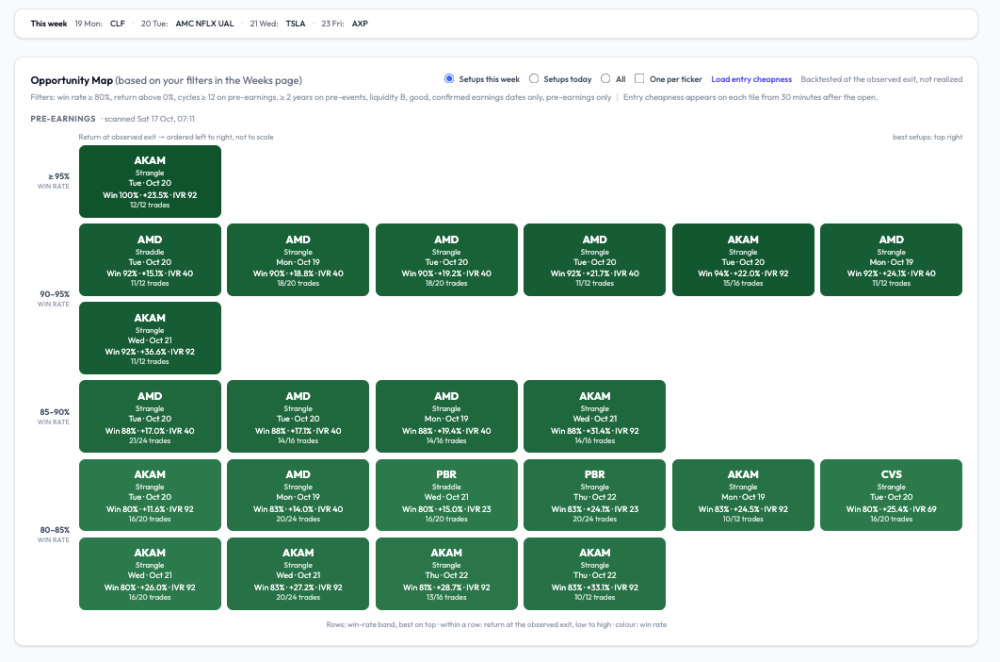
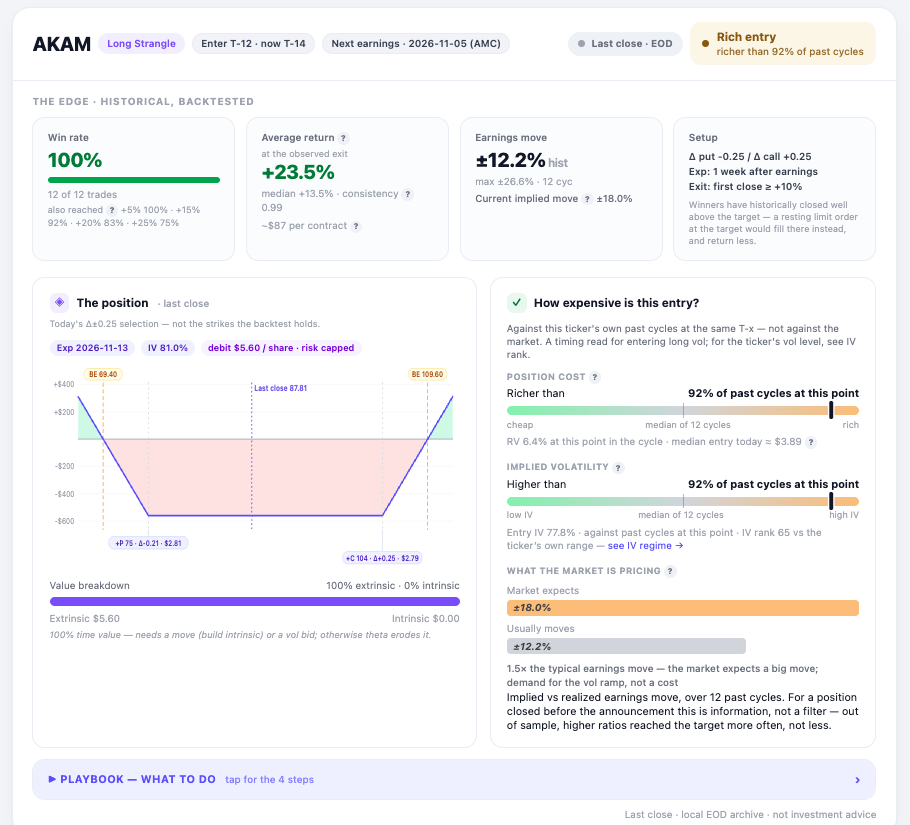
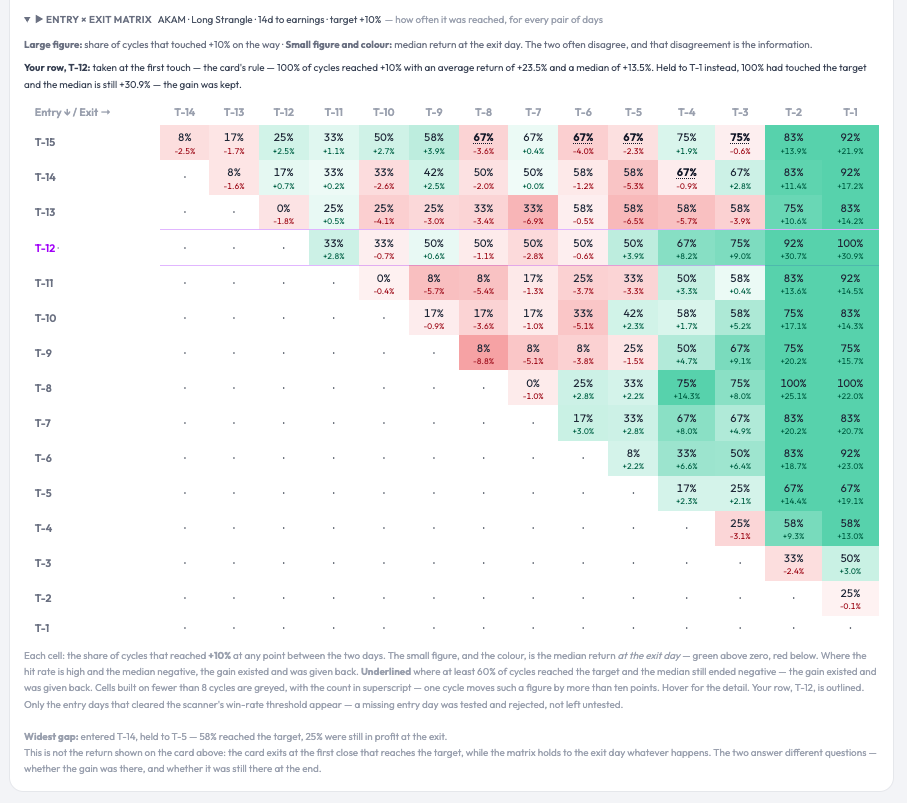
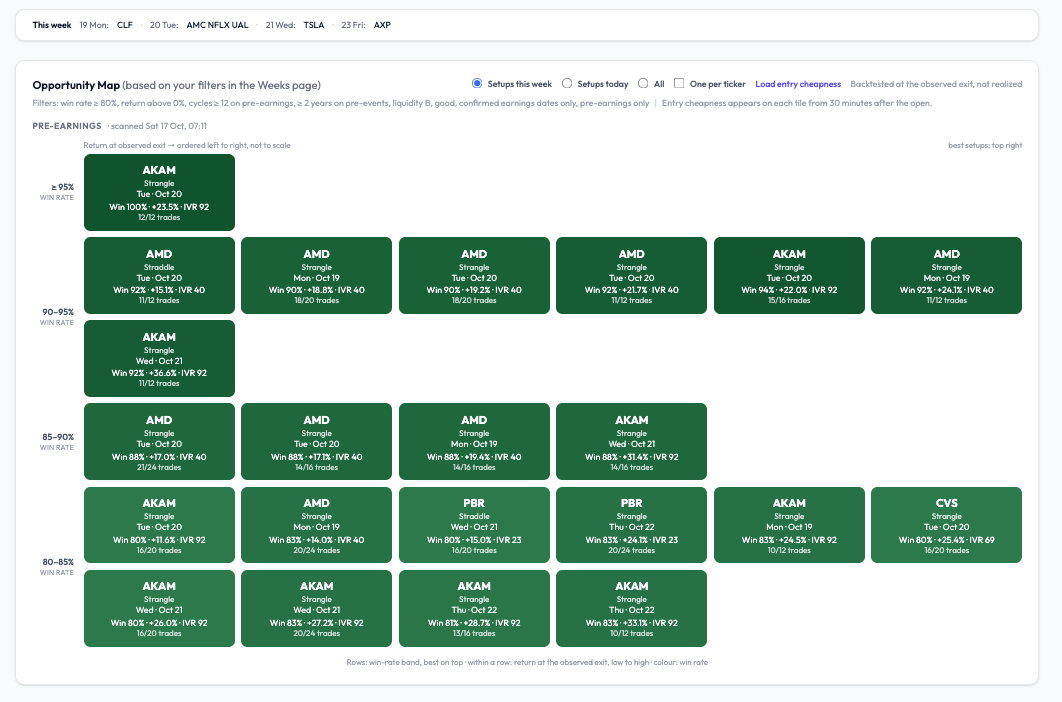
A good-looking pre-earnings week — on paper. The entry will decide. Next week’s scanner is unusually rich in pre-earnings setups with long, clean records: AMD (reports Nov 3, confirmed), AKAM (Nov 5, confirmed), CVS (Nov 4, confirmed), PBR (Nov 10, confirmed). Screenshot below, filtered to confirmed announcement dates only, win rate ≥ 80 %, at least 12 cycles, liquidity B or better. Two things changed in how the grid reads on optionbench, and I’d rather explain them than let you guess. The layout is now an X-Y ranking. Rows are win-rate bands, best on top (≥ 95 %, 90-95 %, 85-90 %, 80-85 %). Within a row, tiles are ordered left to right by return at the observed exit, low to high: ordered, not to scale. So the best setups sit top right, and a tile’s position tells you two things at once without reading it. Colour still encodes win rate. Every tile shows the sample as a fraction (12/12, 18/20) next to the percentage, because 100 % on 12 is not the same evidence as 90 % on 20. The return is “at the observed exit.” That’s the close of the day the position first crossed +10 %, which overshoots the target: AKAM’s +23.5 % average comes with a +13.5 % median. A resting limit at +10 % books less. Both figures are on the card. Now the part that matters. AKAM at T-12 is the strongest line of the week: 12 of 12 cycles reached +10 %, and the entry×exit matrix shows the gain was still there at T-1 in 100 % of them (median +30.9 % held: unusual; on most names the gain exists and has to be taken). Yet today the same card reads Rich entry - richer than 92 % of past cycles at this point, IV higher than 92 % of them, implied move 18 % against a 12 % realised average. The historical record says the setup works; the gauge says Friday’s close was a poor moment to pay for it. Both are true, and the gauge is the one that has been monotonic out of sample: the richer the entry, the worse the outcome, at every level. So the week is promising and no tile is a trade. On each entry day, after the first half hour, the live gauge on the card decides — cheaper than the median, or pass. Click any tile and you get the full card: the historical edge, the live position with its gauges, the playbook (what to do, in four steps), and the entry×exit matrix that shows, for every pair of entry and exit days, how often +10 % was touched and what the median return was if held — the two numbers that usually disagree, and that disagreement is the point. One correction on labelling, since someone will check: when a date shows “estimated”, it means our calendar source has not published a report time yet — the company may well have announced it. The screenshot excludes those on purpose. Romuald - OptionBench.com
 1 point
 -
An OptionBench member asked me whether “rich” pre-earnings vol means we should be selling it. Worth answering in public, because the premise is where most people trip. “Rich” on our gauge is relative: the straddle today versus that same name’s past cycles at the same distance from earnings. It says nothing about absolute vol; and absolute vol is low right now (SPY sits at IV rank 13). Selling index premium here collects little for the same risk. Our structure scanner (it sweeps straddles, strangles, condors, butterflies, debit and credit spreads on 26 ETFs and ranks them by expected value over risk at realized vol) built a SPY bear call spread on Friday and rejected it at 2.4% EV/risk: under the 3% we treat as the friction floor. Selling vol isn’t missing from the toolbox; the toolbox is saying it doesn’t pay this week. Selling single-name vol into earnings because the straddle is rich is a different trade: short gamma into a gap. We backtested that family this summer. The seller’s edge holds as long as nothing moves and collapses on the moves above 10%: a 75% win rate with the losses doing all the work. Not something I’d publish with a win rate attached. What does make sense in a rich regime is what the member actually did: he passed. Entry richness is the strongest single predictor we’ve measured on 95,000 pre-earnings cycles, and it’s monotonic — the richer the entry, the worse the outcome, at every level. Waiting is a position.1 point
-
Please take a look: https://steadyoptions.com/forums/forum/topic/51-email-notifications/?page=4#findComment-216778 It's always worth to enable notifications and/or follow the contributors. Also it is better to post in the members forum and not the public forum.1 point
-
In case you haven't seen it - https://steadyoptions.com/articles/the-last-14-minutes-why-we-stopped-looking-at-options-closing-prices-r837/ The tool now presents 3:46 data rather than closing quotes. This is a game changer. We can now see much more realistic quotes, especially for less liquid options with wider spreads.1 point




This leaderboard is set to New York/GMT-04:00