
Leaderboard




Popular Content
Showing content with the highest reputation on 12/20/25 in Posts
-
Welcome to Steady Options! Please spend few minutes to read this post, the Frequently Asked Questions and the Useful Links. It will be time well spent. SteadyOptions is a premium options trading advisory service. We offer a combination of a high quality education and actionable trade ideas. Our forums and the trading community are the heart of the service. The focus of the service is on non-directional strategies like Long Straddles/Strangles, Calendars, Butterflies, Iron Condors etc. We always trade defined-risk strategies, never naked options. You need to create a forum account to get access to the service. We are sharing our trades with full explanation of the Greeks, the risk/reward, the best time to entry/exit, price targets etc. Full follow-up is provided, including entry, adjustments and exit. You might expect 10-15 trade ideas per month. We will usually have about 4-6 trades open, some are short term (2-6 days), some medium term (3-5 weeks). We use portfolio approach and will have trades balancing each other in terms of theta/vega/gamma. Please note that suggested portfolio size for SO trades is $10,000-$100,000. We do NOT recommend trading accounts larger than $100,000 due to potential liquidity issues. We recommend using one of our other services for larger portfolios. We will also provide options education. I encourage you to ask questions about options trading. Please note that we don't provide auto-trading. SteadyOptions is an educational resource. I want my members to be in a full control of their trading. In addition, SEC considers newsletters that engage in auto-trading to be investment advisers, and I am not licensed to be an investment adviser. So most newsletter that engage in auto-trading are breaking the law and are exposed to lawsuits like this one. You can read more details here. The SteadyOptions forum has several sub-forums (access to members only): SteadyOptions Trades - this is where the official trades are posted. Any trade posted on this forum by any of the contributors @Kim @Yowster @krisbee or @TrustyJules is considered an official trade. SteadyOptions Discussions - This is where we discuss our trades. Unofficial Trade Ideas - This is where we discuss our unofficial trade ideas. In addition, SteadyOptions members have access to all Members forums where we discuss general issues, strategies etc. You can start topics and post on each subforum except “Trades Discussions” and “SteadyOptions trades”. You can reply on “Trades Discussions” forum. Each trade has a separate topic in “Trades Discussions” and “SteadyOptions trades”. The SteadyOptions Trades forum is used for posting our trades. To get notifications about my trades, you will need to follow that forum (by clicking "Follow this forum" button). Each trade has a separate topic, with our entry price, exit price and some comments. We will start a topic for each trade in the “Trades Discussions” subforum and you will be able to post your replies. You will need to specifically follow each forum you want to get updates from. When you follow the forum, you will get an email about every new topic in that forum. If you are interested getting emails about new posts in that topic, you will need to follow that topic. We recommend to follow all forums to get notified when new trade or trade discussion is posted. You can also follow specific members to get notified every time they post. SteadyOptions model portfolio is based on 10% allocation per trade (some trades are 5% and considered half allocation). Average of 5-6 trades is open at any given time. Performance returns are based on the entire portfolio, not just what was at risk. Please note that we usually don't hold our trades through earnings, unless specifically indicated. More details: Why We Sell Our Straddles Before Earnings Why We Sell Our Calendars Before Earnings Our goal is to share our experience and to help you to become a better trader. The trading notifications are based on our real trades that we are sharing with subscribers in real time. SteadyOptions is not a recommendation letter and I am not a financial adviser. However, let me give you few general tips: We encourage you to do your own homework before following any of our trades. If you are new to options or to those strategies, start with paper trading, then start small and increase your allocation as you gain more experience and confidence. Try to understand what we are doing. Ask questions. This is why we have the forum, and we welcome questions and discussions, no matter how basic they are. Don't wait for our notification if you like the trade. Enter if you like it. Exit based on your own profit targets. Our advice to members: learn the strategies and make them your own. Do NOT blindly follow the trade notifications. You need to understand what we are doing in order to adjust your entries and exists to changing market conditions and be proactive. SteadyOptions is a trading ideas generator rather than an alert service. If you are using it as a pure alert service, you are not taking advantage of all the wealth of knowledge and learning we offer. If you expect a pure alert service where trading alerts are just delivered to you without any effort and time commitment, this service is not for you. You will be expected to invest time and effort, please do NOT sign up if you are not willing to do it. I recommend reading My Seven Stages of being an SO Member to get a better understanding of how veteran members are using the service. My commitment to you: I want to make money with you, not from you. All I ask from you is to give me a fair chance. If you decide that you like the style, give it some time to work. Don't give up after a couple of bad trades. We are here for the long run. Don't concentrate on short term performance. Concentrate on your education. Concentrate on managing risk. If you do that, the profits will come. How to make the best use of SteadyOptions For the benefit of the new members, here is how SteadyOptions works and how to make the best use of your subscription. We use a limited number of non-directional strategies, described in the following topics (access to members only): SteadyOptions strategies How we trade straddles and strangles How we trade pre-earnings calendars How we trade Iron Condors How we trade Calendar Spreads How we trade butterfly spreads Full list of "Must Read Topics" is displayed on the right side on the main forum page. Please make sure to read it. You will need a margin account to trade most of those strategies. Here is how we trade the earnings trades: Every week we post post a list of trading candidates for the next week in Earnings Trades Discussions forum. We have some general discussion about the candidates. We will post a separate topic for each candidate I think it suitable, with analysis of the suggested prices, average move, previous cycle etc. The topic will always include a link to one of the relevant strategy topics above. This allows members to do their homework and to see if they like the potential trade. If you agree with the analysis, you can go ahead and make the trade. We will try to get the trade at the best possible price. When we do, we post it under the Trades forum. You should follow this forum to get email notification about the trade. We recommend that you try to get the trade as close as possible to the alert price. We don't recommend chasing trades. We cannot tell you what is the maximum price you should pay. It is your decision. Sometimes you will be able to get the trade the next day cheaper. Sometimes you will miss the trade. We make about 10-15 trades each month in our model portfolio plus similar number of "unofficial" trades. Don't feel obligated to take all of them. After entering the trade, please set reasonable price target. We usually start with fairly aggressive target and lower it as we get closer to earnings. Please look at liquidity, especially if you trade large amount of contracts. For our earnings trades, it is very important to close them before earnings to avoid significant loss. Here is an example of a discussion topic: And a following trade notification: In addition to earnings trades, we also trade different non-directional strategies not related to earnings. There are also many unofficial trades in a dedicated Unofficial Trade Ideas forum. Those trades are not tracked but they are integral part of the service. They are usually posted by me or one of our Mentors and are based on the same strategies as official trades. They don't make it to the "official" model portfolio for various reasons, such as: model portfolio full, size of the trade too big to fit the $10k model portfolio etc. We set different profit targets and stop losses for different strategies, and we also recommend that members set their own price targets. The best way to use SteadyOptions is to learn the strategies and make them your own. If you do that, you will be able to take full advantage of our service. You will be able to make your own decisions, based on our discussions. Getting good fills is part of the learning process. Over time when members gain more experience, they learn how to get better fills. Many members started as complete novices and now they take the trades even before I do and get better results in some cases. But those things take time. I highly recommend following the discussion topics to see how other members utilize the service. I also recommend following our Mentors for valuable tips and insights (more about our Mentoring Program). If you cannot get a fill on the exact trade, there are many ways to trade the same strategy (using different strikes, different expirations etc.) If you understand how our strategies work, you will be able to do it and see what other members do. I see the community as the most valuable part of the service. New members, please spend some time getting familiar with the forum and the strategies before jumping into live trades. Why SteadyOptions is different There are many services that trade exclusively one strategy, like credit spreads. While they might make decent returns 9-10 months per year, 1-3 bad months when the markets make sharp moves can wipe out months of returns. At SteadyOptions, we offer a complete portfolio approach. We use a diversified approach by trading a mix of non-directional market neutral strategies and balancing the portfolio Greeks. In order to hedge our theta positive gamma negative trades (like Condors and Calendars), we will always have gamma positive trades like straddles or strangles. We will discuss the following key elements for our earnings trades: Which strategy is appropriate for the specific stock. When is the best time to enter. What is the optimal entry price. Backtesting of previous cycles. What is the appropriate adjustment. What is the profit target. How Theta, Vega and Gamma impact those trades. Please make sure to read Frequently Asked Questions for more details. Finally, a quote of one of our members: I see SO as an educational course with live trades examples and the ability to discuss them with a like minded community. I don't expect or frankly care to perform as well or the same as the official returns, for the most part I don't even enter official trades unless it fits with my own strategy. Or the sectors/symbols that I like investing in and a myriad of other factors. So far, I learned a great deal directly and indirectly from SO and see a good ROI from both trades and knowledge accumulation. The truth is that about 90% of options traders will either breakeven or lose money. The same applies to any competitive sport or business, 90% will give up and stop playing, 9% will be considered average or good players and the top 1% the pro athletes will thrive. The copy and paste approach doesn't work for options... there are no shortcuts. Don't expect to look or learn how a marathon runner is running and expect to be able to run the marathon faster or even at the same pace. A person search for a one solution fix all or the "holy grail" is futile, there is no such a thing. The only thing that works is hard work, dedication and continuous learning. Every athlete will tell you the same.


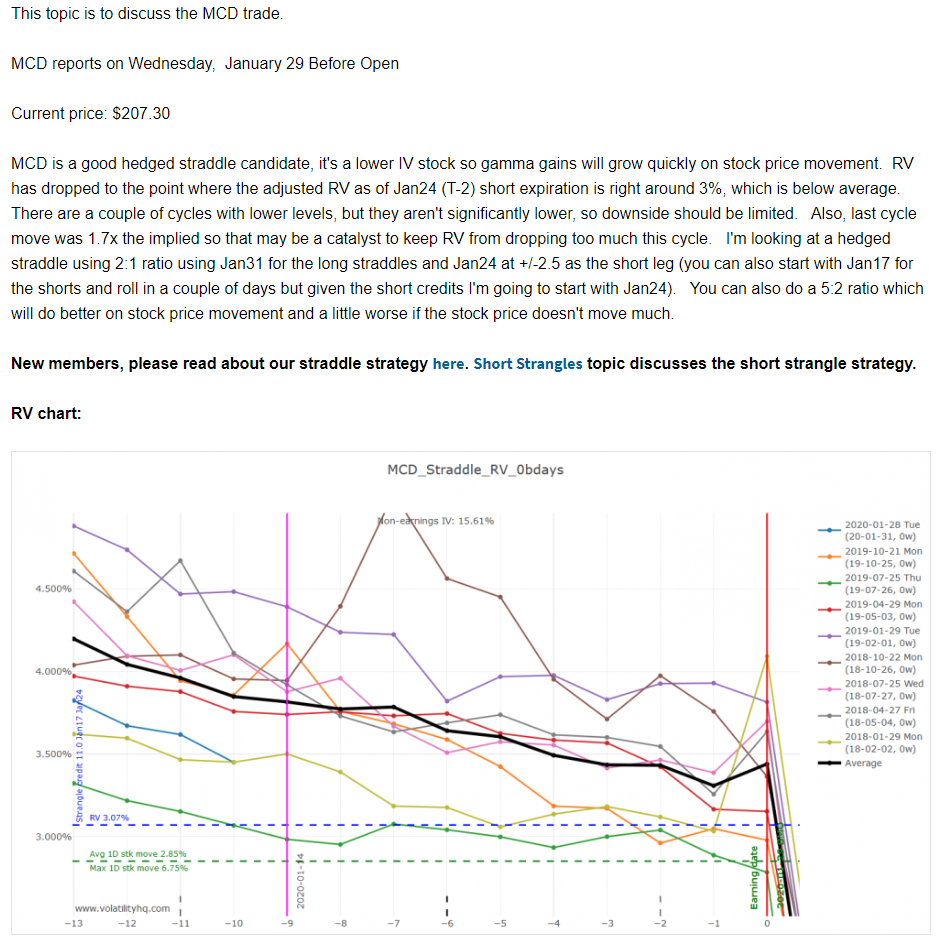
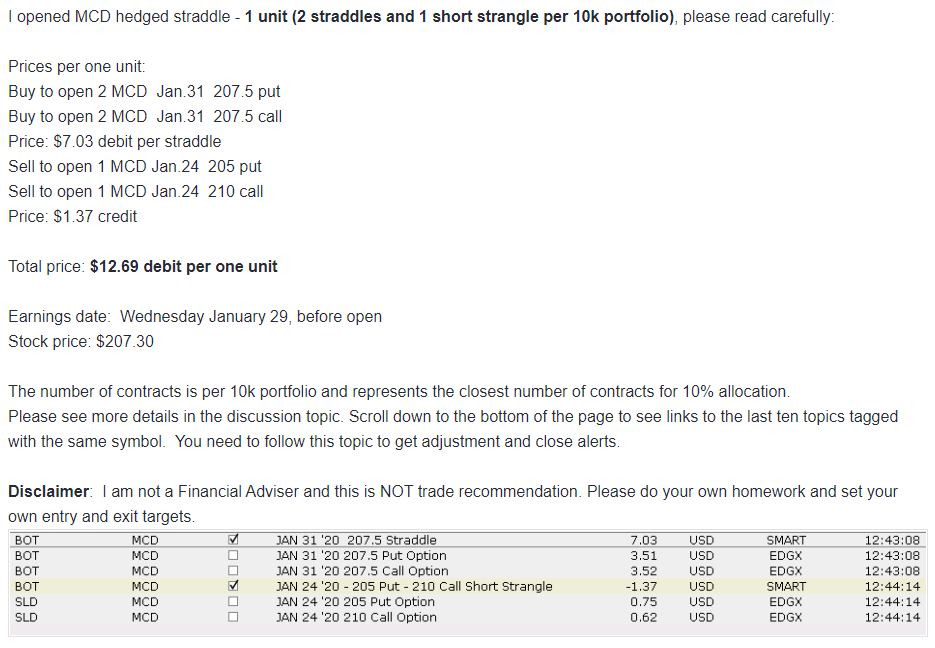 1 point
 -
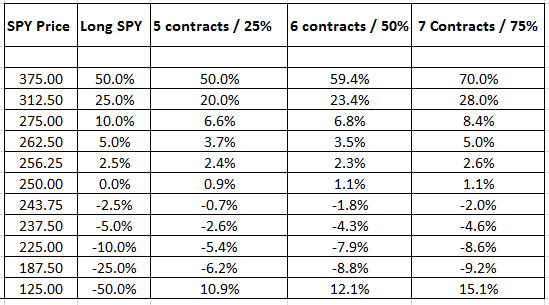
Important: the first part of this post describes the general concept of the Anchor strategy. In January 2019 the implementation has been changed and Leveraged Anchor was born. The Leveraged Anchor implementation is described in the second part of the post The strategy description has been provided by Chris Welsh. Welcome to Anchor Trades! I would like to personally welcome all our members, those who have come from SteadyOptions, Seeking Alpha, and those which have come from elsewhere. I would encourage everyone to read the Anchor Frequently Asked Questions and the Anchor Trade Strategy topics. Those two topics should provide answers to the majority of your questions, as well a detailed discussion on what the Anchor Strategy is all about. You can see the Anchor Trades performance here. So What is an Anchor Trade? To put it simply, an Anchor Trade should be one that forms the keystone of any investment portfolio -- that reliable corner that you know you can depend on, regardless of market conditions. The one that lets you sleep at night, knowing your money is at work, but not subject to large risks. An Anchor trade's goal is to prevent loss of capital while still generating a positive net return in all market conditions. This strategy began with the premise that it must be possible to virtually fully hedge against market losses, without sacrificing all upside potential. Anchor trades are concerned for full year, full portfolio, protection, regardless of market conditions. Many investors try to insure against losses after those losses have already been incurred, or as they are occurring in real time – this is a mistake. It’s easy to be an investor during a prolong bull market, but what happens when a severe, or even mild, market correction occurs? At that point many investors find themselves trapped in falling positions, have stop losses kicking in, and are at a loss as what to do – other than to watch their principle dissipate. In the modern era of flash crashes, swift market volatility changes, and world risk it simply makes no sense to be invested in anything without portfolio protection. It is impossible to routinely predict the next negative major market event, therefore 365 days of protection is a necessity. I have given up trying to predict the day to day movements of the market -- therefore I Anchor my portfolio with this strategy (which can easily then be paired with other strategies). In the current market environment, such precautions are particularly warranted. It is my opinion that much of the recent market gains have been artificially propped up by low interest rates, the Federal Reserve, and the lack of alternative investment choices which can provide income to investors. At some point in the future the market is due, at the very least, for a correction, if not a significant down turn. With increasing turmoil in Syria, North Korea, and elsewhere in the Middle East, who knows what could tip the markets. Will this occur within two weeks, six months, one year, or even longer is something I've given up trying to predict. Rather I seek to protect against such events – whenever they may occur. Some strategies try to partially hedge against market risk through long short strategies, through the straight purchase of puts (typically out of the money at a substantial cost to the portfolio), through default swaps, or through numerous other instruments. However, each of these strategies only offers partial portfolio protection which either comes at a cost or which just assumes a set loss in the portfolio (such as ten or fifteen percent) is acceptable. I refuse to accept that philosophy and have developed a strategy around annual portfolio protection. Performance targets The impact of not experiencing losses in down market years, while only slightly lagging (if lagging at all) in positive and neutral years, is astronomical over any extended period of time. Utilizing the Anchor strategy over a number of years, particularly if any of those years are bear markets, should lead to the strategy significantly outperforming the markets as a whole, as back-testing has demonstrated. Even in prolonged bull markets, the returns should still be positive and lag negligibly behind. The peace of mind which comes with being fully hedged more than compensates for the potential of slightly underperforming the market as a whole in prolonged bull scenarios. Special thanks to Reel Ken, Kim Klaiman, and others who helped me evolve this strategy to its current form through their articles and discussions. Anchor Trade objective The Anchor strategy's s primary objective is to have positive returns in all market conditions on an annual basis. Anchor Trades will be divided into two separate forums: 1. The Anchor Trades forum will post my actual trades from my individual account, including weekly rolls, and any adjustments I make, as well as the price I received when filled. It will also include a thread for "model" trades that will be launched monthly. Model trades will be for those members who join after the initial actual trades are established, so any member can set up their own Anchor Portfolio. This way any member, regardless of when they join, will have a thread to follow applicable from their initial membership date. If you want to get notifications about the trades, you should follow this forum (by clicking "Follow this forum" button). If you follow this forum, you will receive an email when a new topic (trade) is posted. 2. The Anchor Trades Discussions forum will discuss each trade that has been made, detail the calculations behind the decision, and provide a Q&A forum for members to ask about any one trade. The thread will also have columns about the theory behind the Anchor strategy, implementation discussions, and be open to members to ask general questions. The Anchor objective is to produce equity like returns over a full market cycle, with reduced volatility and bear market drawdowns. If you have any questions about the threads, where information can be found, or just general questions, please feel free to send a message to either Kim or myself. I look forward to helping all member learn about this strategy and hopefully implement it themselves. January 2019 update - Leveraged Anchor In January 2019 we started tracking the leverage version of the Anchor for performance purposes. The leveraged version has been extensively backtested to fine tune the system for optimal results. Here are the highlights of the new implementation: We now use deep in the money calls, as opposed to long stock positions, and we are able to gain leverage without having to utilize margin interest. Given the rising interest rate environment we are in, and the high cost of margin interest rates generally, this can lead to significant savings; When we enter the trade, we look for a long call that has a delta of around 90. As the market falls, delta will shrink. For instance, if SPY were to decline ten percent, our long calls would have declined by less than nine percent. The closer we get to our long strike, the slower this decline; In the event of very large crashes, we can actually make money. See How Anchor Survived The 2020 Crash. Losses are capped. In the below example, the maximum loss is 9.5%. This can increase if we keep rolling the short puts throughout the downturn, but in any one “crash,” losses are limited to the ten percentage point mark (in Traditional Anchor this 9.5% max loss in one period is better, coming in at 8.5%). If we apply a momentum filter as well, then the risk of continuingly losing on the short puts declines; Please read The Downside Of Anchor for more details. In larger bull markets, the Leveraged Anchor outperforms both Traditional Anchor and simply being long stock as there is actual leverage being used. Some of this will depend on just how fast the market is rising and how often the long hedge is rolled, but in large bull markets, it should still regularly outperform. In fact, in any one period where the market grows more than 3.5% to 4.0%, the Leveraged Anchor will outperform simply being long SPY. The Leveraged version of Anchor will always outperform Traditional Anchor in any up markets. One question that must be addressed is just how much leverage to use? Luckily this is very easy to model on a thirty day period, with SPY at 250: Above is a table showing the performance of SPY, then using 25% leverage, 50%, and 75% leverage after certain market moves over a thirty day period. After reviewing the above, and similar tables over longer periods of time, we made a decision that utilizing 50% leverage was optimal. You of course can adjust, taking on more leverage, or less, as you see fit. Note the above table does not include any gains from BIL dividends. That should add around 10 to 20 basis points more performance per month on the leveraged versions. Overall, we should expect the leveraged to slightly outperform the market in strong bull markets, significantly outperform in strong bear markets, and slightly underperform in sideways or slightly up/down markets (+-10%). You can read more about the strategy here. Since inception, the leveraged Anchor is up 296.0%, compared to S&P 500 return of 173.1% (as of 12/31/2025). We also recommend reading How Anchor Survived the 2020 Crash. On March 19 2020, SPY at 234 (down 30%), Anchor UP $5k (~3%). Click here for a full analysis of 2022 performance.
 1 point
 -
My view is that the strategies described here give the conditions for their optimal use. The stockmarket is a bit seasonal in that some strategies such Iron Condors work better when volatility is higher and therefore should be avoided if it is lower. The calendars we have often traded have also been less attractive in the last few iterations and the strategy descriptions indicate what to look for. The trades are announced in the discussion thread first on the day of the trade but the potential targets for earnings trades - which are a large part of SO strategies - are presented each week. RV is used very frequently and you are right that Chartaffair and Vol.HQ are the primary sources there. One Option Explorer is primarily used for back testing and looking at possible outcomes of strategies for the rest many many tools or personal research have been used.1 point
-
Kim could plz inform me of the procedure for researching and finding those candidates? - Do you go to VolatilityHQ, check the earnings dates, that are 3 weeks out for example? - Are there any criteria for selecting from those? (Must have Weeklies?, Have a certain amount of Open Interest, Volume? etc...) - How to determine the Strategy you will use? (Straddle, Strangle, DD?). Is it Non earnings IV? Is it the VIX? - Do you check the Return Matrix Table, (Long Stock?, Long Call?) to check the Pre Earnings behavior? Do you select the Entry Day based on this table? (T-19, T-15, etc)? - If we want to find the RV for a Strangle, do we use the Straddle RV and make some assumptions? What about the RV for a Double Diagonal? Sorry to overwhelm you with so many questions, but i try to correctly understand the procedure, so that i can learn as fast as possible, and contribute, to this awesome community.1 point
-
As mentioned in the first post: Here is how we trade the earnings trades: Every week we post post a list of trading candidates for the next week in Earnings Trades Discussions forum. We have some general discussion about the candidates. We will post a separate topic for each candidate I think it suitable, with analysis of the suggested prices, average move, previous cycle etc. The topic will always include a link to one of the relevant strategy topics above. This allows members to do their homework and to see if they like the potential trade. If you agree with the analysis, you can go ahead and make the trade. We will try to get the trade at the best possible price. When we do, we post it under the Trades forum. You should follow this forum to get email notification about the trade. We recommend that you try to get the trade as close as possible to the alert price. We don't recommend chasing trades. We cannot tell you what is the maximum price you should pay. It is your decision. Sometimes you will be able to get the trade the next day cheaper. Sometimes you will miss the trade. We make about 10-15 trades each month in our model portfolio plus similar number of "unofficial" trades. Don't feel obligated to take all of them. After entering the trade, please set reasonable price target. We usually start with fairly aggressive target and lower it as we get closer to earnings. Please look at liquidity, especially if you trade large amount of contracts. For our earnings trades, it is very important to close them before earnings to avoid significant loss.1 point
-
Hi Kim - plz let me know when Steady Options is available for new members. I am interested to subscribe. Thanks1 point
-
I'm pleased to announce that our long term mentor @TrustyJules will become a contributor and start posting official trades. He is likely to start with his famous SPY IC "boring trade", but might add other strategies over time. SteadyOptions has now four official contributors: @Kim @Yowster @krisbee and @TrustyJules I recommend following all of us, it will save you time to follow each trade individually. We become better and better over the years!1 point
-
Our main strategies are straddles, strangles and calendars. I assume calendars fall under definition of spreads, so they should qualify. All our trades are defined risk, never naked. Hope this answers your question.1 point
-
Hi. I've spent last four hours reviewing your site and am very interested in learning to trade options with you guys. I have a couple of rollover IRA's and a Roth IRA with Fidelity. My intent is to gradually apply my Roth money to the Steady Options program, in 10K increments and let it accumulate for 5 or 10 years. Fidelity advises that Options trading on IRAs includes Buy-writes, Selling covered calls, Rolling covered calls, Buying calls/puts, Selling cash covered puts, Long straddles/strangles, Spreads (up to 4 legs). QUESTION: Are these options adequate to cover the strategies that you use with SO? I am a beginner, but am willing to start slow and learn. I really appreciate everything I've read so far. From Fidelity Web Site: Options trading on IRAs includes: Buy-writes Selling covered calls Rolling covered calls Buying calls/puts Selling cash covered puts Long straddles/strangles Spreads (up to 4 legs)1 point
-
Hello, I don't know where to ask it, but could you please let me know when a Steady Options spot is available ? Thank you for your help ! Thomas1 point
-
This article is 10 years old. It describes the general concept, but a lot has changed since then. You can find the symbols we trade on the subscription page. There is no specific list, but many symbols repeat from cycle to cycle.1 point
-
Is it please possible to post the 100 stocks with high IV's mentioned here, so it helps in understanding and application of principles. I do not have premium access to seeking alpha , appreciate the help ------------------------------------------------ , Which stocks should be used? I tend to trade stocks with post-earnings moves of at least 5-7% in the last four earnings cycles; the larger the move the better. When to buy? IV starts to rise as early as three weeks before earnings for some stocks and just a few days before earnings for others. Buy too early and negative theta will kill the trade. Buy too late and you might miss the big portion of the IV increase. I found that 5-7 days usually works the best. Which strikes to buy? If you go far OTM (Out of The Money), you get big gains if the stock moves before earnings. But if the stock doesn’t move, closer to the money strikes might be a better choice. Since I don’t know in advance if the stock will move, I found deltas in the 20-30 range to be a good compromise. The selection of the stocks is very important to the success of the strategy. The following simple steps will help with the selection: Go to here. Filter stocks with movement greater than 5% in the last 3 earnings. For each stock in the list, check if the options are liquid enough. Using those simple steps, I compiled a list of almost 100 stocks which fit the criteria. Apple (AAPL), Google (GOOG), Netflix (NFLX), F5 Networks (FFIV), Priceline (PCLN), Amazon (AMZN), First Solar (FSLR), Green Mountain Coffee Roasters (GMCR), Akamai Technologies (AKAM), Intuitive Surgical (ISRG), Saleforce (CRM), Wynn Resorts (WYNN), Baidu (BIDU) are among the best candidates for this strategy. Those stocks usually experience the largest pre-earnings IV spikes.1 point
-
Seems to me SPX weeklies appeared in 2005 and were introduced by CBOE. It should be enough to make backtesting over 2007-2010 declining market. Another approach might be price approximation using implied volatility + theoretical price (from Black Sholes or more advanced models) + price of monthlies. For me, Anchor scheme is quite expensive over high volatility downtrends market when the price of hedge is high. The backtesting will show - is it still more profitable than the index in the long run or not.1 point
-
Anchor behaves exactly as designed. No strategy can outperform in all market conditions (except for Madoff maybe), but those who followed the strategy from the very beginning are still crashing the S&P 500 with less volatility.1 point
-
Our long term members know that we always post the most accurate and transparent numbers, bad and good. In some cases the numbers can be delayed by few days, but they always are posted. April numbers are published now. To put things in perspective, this is the Anchor performance since inception on Jan.1 2019 till Apr.30 2022: Anchor: up 98.7%, 22.9% CAGR S$P 500: up 64.9%.1 point
-
Dear Mr. Fred, SO is currently in capacity controlled mode. We can accept only a limited number of new members, and we are only interested in serious traders dedicated to their professional development. I believe that reading the Welcome to SteadyOptions post and Frequently Asked Questions, viewing our reviews and analyzing our 10+ years performance should give you a pretty good idea if the service is a good fit for you. I also believe that you need at least 3 months anyway to get a "feel" of how the service works.1 point
-
Dear Kim, I've got the invitation and wanted to join, but I'm a bit disappointed that there is no free trial anymore/at the moment. a) Why is that the case (it is still shown on the subscription page)? b) I wanted to subscribe to the monthly option at first to get some experience with it, but i do not see this option on the subscription page? I have not been a member before, so - in my understanding - i should be able to choose monthly? Please explain. Thank you!1 point
-
SteadyOptions service is currently by invitation only. Invitations are sent to members as spots become available. New members, please make sure to leave "Send me updates" field checked when creating a new forum account. The goal is to control capacity and provide the best service to existing members. Please note that all bundles are still available. If you subscribe to all services bundle or 2 services bundle (1 year or 2 years), you still get the SteadyOptions service as part of the bundle.1 point
-
SteadyOptions is currently closed to new members. We will notifiy all registered members when we have available spots. There is no need to post here.1 point
-
October 2021 update: Many of our current and former members know our long time mentor @krisbee for his highly valuable contributions to SteadyOptions community. Many of you learned to appreciate his high professionalism and patience. I'm pleased to inform all members that going forward @krisbee will start contributing trades to our official model portfolio. The performance numbers on the performance page will include all trades from the official model portfolio (posted under SteadyOptions Trades forum). This will allow us to expand the quantity and the quality of our trades, sometimes providing a slightly different angle and perspective. SteadyOptions is getting even better! Now you will get official trades from THREE traders for the price of one! This means more selection and more diversity. Those who followed @Kim and @Yowsterto get the posts in trades and discussions forums, please don't forget to follow @krisbee. Of course you can also continue following the forums and the topics. Happy trading!1 point
-
The risk on capital is not higher, but the risk on the whole account is. The Anchor largest drawdown in 2020 was around 10%. So assuming $100k account, that would be around $10k loss. If it used your method, you would buy the same number of contracts but could use it in a $20k account. So your loss on the whole account would be 50% instead of 10%. Yes, you could use it in the same account and have more cash. This maybe would be beneficial if you could get some risk free return on this cash. Otherwise it's really pretty useless.1 point
-
So after thinking about this further I do understand what you mean by I'm using more leverage. With your trade you are risking about roughly 15% of the capital deployed where I'm risking 100% of the capital deployed. So based on that if I increase my size at all I am absolutely adding more risk to the trade. With that said again if somebody had a smaller account they would be risking a much higher percentage of it. However I still believe that my approach for the same size account as you recommend would be a better use of capital as I have roughly 18,000 that I can just keep in cash versus put in the trade1 point
-
Using the same amount of cash on a smaller account means much higher leverage. Which means you will have much higher losses and drawdowns when the strategy works against you. The amount of leverage is determined not by the cash used, but by the amount of the stock you control. For example, if you have 100k account and SPY is at $440, buying 4 contracts means you control $176k worth of SPY stock. If you use a smaller account because you can buy the same number of contracts using your synthetic position for less cash means much higher leverage and higher risk.1 point
-
Chris, Thanks for the reply and clarifying the dividends as that's the number TOS gave me. However on the margin side (I know you are not using margin leverage). If I set up the basic position today using your method it would look as follows: Long 1 16 Sep 22 call @ 255 Long 1 16 Sep 22 put @ 435 Total cost = $218.75 My suggestion is: Long 1 16 Sep 22 put @ 255 Long 1 16 Sep 22 call @ 435 Total cost = $37.51 While these might not be exactly what strikes you would pick the example still holds. The two positions are synthetically the same. However my approach would yield the same dollar returns but much higher % on capital. Plus I can trade this which a much smaller account now. Additionally since I am using so little capital compared to the original approach, I can buy closer to the money puts and still be way ahead of the game as far as capital in the trade and thus have much greater downside protection. So what am I missing?1 point
-
The strategy uses NO margin and you even have cash left over to control the synthetic leverage you are obtaining. The current yield on SPY from dividends is 1.3% (not 5%), which is baked into the option prices (trust me, I've beat my head on the wall on arbitrage dividend capture strategies for years, those are really priced in.1 point
-
This is a very interesting system/method. However, in less I am missing something you are not using your margin efficiently as you could and thus could get even better returns. The position set up you recommend includes a DITM call and slightly OTM put. However this is synthetically the same as using an OTM Put and a slightly ITM call. The big difference between the two is although the risk is the same, the cost (margin) required for your set up is 5 - 6 times greater than the cost of the synthetic alternative. I confirmed this with TOS as well as modeled it out. So this is a big opportunity to trade this in a much smaller account as well as having much better results if you use the same amount of margin but use the OTM options. Secondly, when comparing to buy and hold, you do need to consider that the SPY does have approximately a 5% annual dividend which of course you do not get when using the long term options.1 point
-
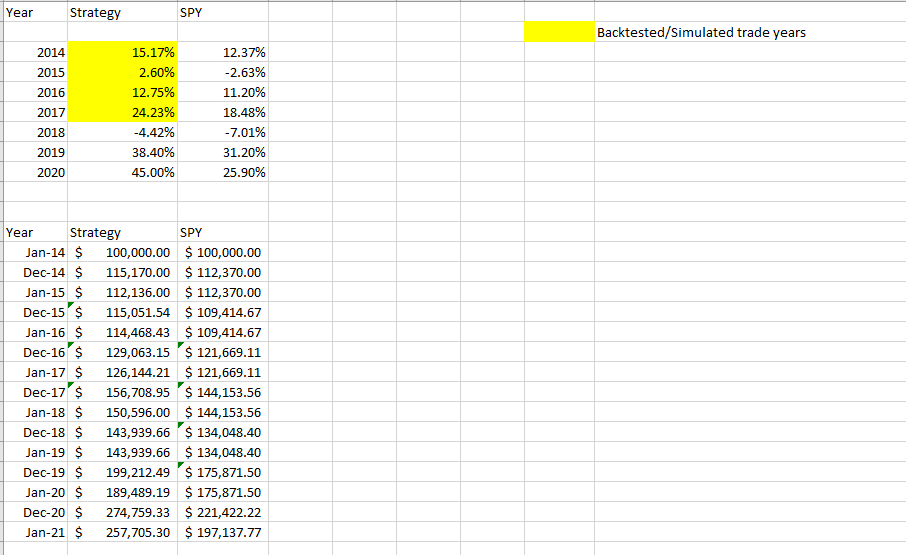
I should make an entire thread on this. The short answer is that it is more efficient than a normal high frequency trading, as we manage for long term capital gains, so higher income tax brackets hopefully won't matter as much. The bad news is that it is not as TAX efficient as long term buy and hold. However, any advisor will tell you managing for taxes is not the worlds smartest move. For example, buying a tax free muni that pays 0.02% vs. buying a just as secure taxable bond paying 5% would be a dumb decision. That said, there are situations where we do "in year" rolls on the calls -- rarely for a profit though, and if it is, then the profit likely won't be large. In-year rolls are almost always after a large market draw down. Due to the frequency of this question when I've been out marketing the new fund, I put together the following spreadsheet (NOTE THIS IS NOT TAX ADVICE, it's merely my theoretical calculations, everyone's tax situation is different). The chart assumes trading Anchor on SPY, which rolls every year vs. just holding SPY, and starting with a balance of $100,000. Every December, the end of year balance was taken in the "Strategy" column, and long term capital gains were applied. Granted this is a rough calculation, as the rolls don't happen on December 31, but it shows what I want it to fairly well. The above is reality, but I have manipulated the series of returns, and here are the general conclusions: 1. If the strategy performs as expected in large up markets, even paying taxes, you're better off; 2. If the strategy performs as expected in large down markets, even paying taxes, you're better off (often significantly); 3. If the strategy performs as expected in flat to smaller down markets, you are probably better off in SPY, but that's because the strategy under performs, NOT because of taxes (in that case, you'll actually have a taxable loss in both situations); 4. In smaller up markets, you are better off in SPY. The Anchor strategy aims for market like returns with less volatility. On a extended period of time that should lead to market outperformance, even including taxes. However if we have a "lost decade" type market, where we see 5-10 years of market returns between 5% and -5% and also low volatility, we most certainly will underperform. Provided of course that carries across everything we're diversified in. If you're looking for a "simple" rule, if both SPY and Anchor returned exactly 10% for five years and then you exited both positions, SPY would be up about 48.8% and Anchor would be up 46.9%. (That's the difference in taking 10% per year and paying your 20% taxes every year and taking 10% per year and paying your 20% taxes at the end). Obviously if you don't EVER sell the position, the difference is more dramatic.
 1 point
 -
what is the tax adjusted returns for this strategy ? i am in a high tax bracket, with the frequent trades and not being able to compound my earnings, due to tax payments, how much ahead of the index will I be ? do you have any projections from your prior performance how this would perform against a buy and hold approach after factor in the capital gains tax savings and effects of compounding?1 point
-
@cwelsh , I'm not sure I've seen this specific question addressed. Between my wife and I our employer tax deferred retirement accounts (403b/457b) have grown and have become a pain to manage, causing me to lose some sleep at times with the risk I'm carrying there. It dawned on me and I think this is possible to use Anchor here. Could one buy an S&P equivalent index matching fund (like VIIIX or VFIAX) in those employer accounts, beta-weight that combined position against SPY and employ the anchor hedging gadgets in my IRA? I think the ITM call could be synthetically made by buying a beta-weighted number of long puts at the same expiration and strike as the ITM call in the IRA. I realize there would be no leverage but at that point I wouldn't really care as there would at least be protection in the aggregate of tax deferred accounts. Would there be any other limitations, such as if anchor sells shorter duration calls against the long duration ITM call (where then I wouldn't have a long call in the IRA)? If not I think it might work. Let me know what you think or if I'm missing anything. Thanks, Tim1 point
-
Hi, please add me to the waitlist for Steady Options. Thank you!1 point
-
Hi, please add me to the waitlist for Steady Options. Thank you!1 point
-
@cwelsh Hi Chris, I am a new member still trying to understand the total strategy. I started with the How To Start... topic, and have read almost everything in the forum. I cannot find a description of the "general rules" for rolling, or general maintenance rules of the portfolio positions. I understand when to roll, but it seems sometimes we roll the long puts to an expiry beyond the expiry of the long calls. Am I understanding that correctly? We roll the calls and puts with expiry independent of each other? When rolling long puts what is the guidance for choosing expiry? If this is available as a forum post, please redirect me to it. Thanks!1 point
-
Hello, I'm interested in the Steady Options service. Please, add me to the wait list. Thank you!1 point
-
@cwelsh So expanding on the question above about trading this strategy in an IRA -- how much drag on the returns are there when the options have to be cash secured? I'm assuming there must be members that trade this in a 401K or IRA but it seems like the model portfolio and performance pages are showing what this looks like in a regular margin account. So when there is a market drawdown does this mean the IRA account holders wouldn't be able to use some of the strategies you've written about and implemented in 2020 to help catch the market upswing after a big drop? I specifically refer to your article in April that went over 4 different options to utilize with Anchor if you wanted to participate in the upside.1 point
-
Is the $150k a barely tolerable minimum that good cause problems or a good rational choice to start with? The reason I ask is that the numbers you posted show zero wiggle room at 40k so I wonder if 50 is sufficient. I'm sure after I have familiarized myself with this approach that I would have the answer, but I'm just now looking at "Anchor" so don't really have an opinion yet.1 point
-
Hello Kim - I am interested in steady-options service, can you please add me to the wait list? Thank you in advance.1 point
-
Hello Kim, Please let me know when you have an opening at SO. I started trading after Investools program 2012, I've been at Sheridan for the last year. I like your approach and think I could learn a lot here. thanks! Dave1 point
-
I would like to be added to the wait list on Steady options; I trade options, but only the basic puts and calls and have a small account. It be great to learn how to do things like Iron condors, various spreads, etc.1 point
-
As mentioned on the subscription page, The Bundle subscriptions include all current and future services. That includes SteadyOptions and all other services.1 point
-
Hi Kim, Really interested in joining steady options as well. Not sure what else is required for sign up? If I choose the one of the bundles am I still in a wait list position? What type of time frame before spots open up? Colin1 point
-
Hard to say. People were saying 10 years ago that iron condor will be dead once too many people start using it. The liquidity issue in our case is not related to a strategy. If we traded only stocks like SPY or AAPL, we could trade tens of thousands of contracts. But buying 1,000 contracts on less liquid stocks could be tricky. The market simply doesn't have that kind of liquidity. As for the strategies themselves - as long as traders have different opinions and different views, the strategies will continue working. As you correctly mentioned, it's all about management. But nobody should try and trade those strategies in a fund. Please trust us on this.1 point
-
@Kim Do you think that the about 100k account size limit for the the SO strategies due to liquidity is one reason why the strategies work so well and have not gotten crowded or arbed away? The strategy is therefore not feasible even for tiny funds or family offices. And for most retail traders it might be to "complex" or have a too long learning curve (therefore they might be more attracted to the selling premium story). I think that SO is a bundle of strategies and the permanent adaption to the changing market environment and also the portfolio management of the different strategies which hedge each other kind of are other reasons why SO has been consistently profitable. But do you think that the about 100k liquidity cap is kind of a boon for SO?1 point
-
Just found out about your website. looks impressive. Please consider me for a spot on steady option when it opens. Look forward to making profits and learning.1 point
-
The problem comes in hedging, as the prices do not move in unison. E.g. if SPY drops $1 a VIX call is not going to go up $1. I just pulled both charts for today, SPY is up 1.7% and VIX is down 3.2% -- so not only can you not match dollar moves, you can't match percentage moves. I'm not saying there's not a way to do it -- and it might even work better in very large moves down (as VIX can go through the roof quickly), but I'm not sure how comfortable I'd be using as it replacement for SPY puts.1 point
-
a. You should roll the calls either (a) after a full year has gone by and you can sell them for a long term gain instead of a short, or (b) after a large market decline to be able to participate in a market rebound. Item B merits discussion. One of the advantages of using long calls is as the market declines, so does the delta of the long position. When the position was opened, delta may be around .9 -- which means if the market drops $1, the long calls go down $0.90. However, as things decline, so does the delta. So after a crash, the delta might be 0.7. This means if the market keeps going down, your long position is declining at a decreasing rate, while your long puts have a delta near one. So in Leveraged Anchor, you're actually better off with a BIGGER crash, as your account can start going up in value. We saw this actually occur over the last month. The trade off is as markets rebound your account will go DOWN in value. This can be combated by, at some point during a decline, rolling the calls down and out to a higher delta. The disadvantages of such a move include (a) it requires cash, (b) you are realizing a loss on the calls while not realizing a gain on the puts, and (c) if the markets keep going down, you'll be worse off than if you had not rolled down and out. Of course the long puts are still there, but you will be a bit worse off. a. As for when to roll the puts, the general answer is only as things go up. I did post an article discussing when this may not hold true: https://steadyoptions.com/articles/anchor-analysis-and-options-r564/. b. We normally by the hedge of the long calls 5% out of the money. They're significantly cheaper than an ATM position. For instance, the March 31 2021 at the money put (280) is currently trading at $32. 5% in the money (266) is around 26.50. The first ends up costing the portfolio about 11.5%, the second 9.5%. So in essence we're "risking" a 3% down turn to get a cheaper hedge. Given the postive skew of markets over time, and the fact the biggest drag on the portfolio is the hedge, this is a tradeoff most members are happy with. Though some DO stick to the ATM hedge. But then we also have to hedge the short puts, which are the most risky portion of the portfolio. We use ATM puts for that to reduce risk. c. It depends on if its a new or old portfolio. For the older ones, for instance the model portfolio, we currently are hedging the short puts at SPY 327, which has a delta of almost one. So selling a 55 delta put has relatively low risk. The premium is huge (which is necessary to pay for the more expensive hedge), and the long 327 puts do an awfully good job of hedging it if the market goes down. If you're opening a new portfolio, yes the risk is higher, but you also need the higher credits to pay for the hedge. If you're risk adverse, you can always move toward the ATM position, but be more aggressive rolling. d. Cost, delta, and necessity for adjustments. On the long call side, your 435 day 200 call (first available after one year), is trading at an .88 delta, the same position 652 days out costs $3 more and has a .82 delta. Not the largest swing, but one that will make a difference in an up market. It also cost a bit more to get the same leverage. On the put side, the same thing applies -- only as we anticipate having to roll the hedge up and out as markets rise, by moving further out in time, you've cut the amount you can roll "up and out." e. When I purchase the options, I always open the order well off the mid in my favor. For instance, if I was buying a put and the spread was $1 - $2, I'd probably open the order around $1.25 or so and slowly increase it by a few cents every 30 seconds to a minute. f. You are 100% correct -- if vol stays where it is, then the increased volatility will make paying for the more expensive hedge simple. However, if vol drops back to normal levels in a short period, you'll be in trouble. Another thing to think of, as volatility drops, markets are likely going up -- which means you may have to roll the long hedge frequently (about every 7.5%-10% in market gains). This increases cost even more, while at the same time the credits you get are declining. I currently want to see the cost of the portfolio hedge at 8.,5% or lower to feel comfortable. There's no magic with that number, it's what I'm comfortable with, for those entering a new Anchor, at these levels, they may still be able to pay for the hedge. g. Target leverage is based on an individual's risk tolerances. More leverage equals more risk in small market drops. It also is more volatility, as prices will move more. It's fairly easy to find the differences different leverage will have using excel. Just build out the position with various amounts of leverage, and then calculate the value of the portfolio on various stock ending prices. h. SPY is more liquid and more representative of the whole market -- QQQ is tech slanted. If you have $200k or more, then you could implement a diverse Anchor using IWM, EFA, QQQ, and SPY. i. We've tried a variety of different hedging techniques and learned that any hedge that does not exactly mirror the underlying instrument results in tracking error at some point. For instance, at one time we tried a basket of stocks that we liked and hedged with SPY. Worked great until dividend stocks really under performed SPY and we were heavy in dividend stocks. We tried using a blend of similar instruments to SPY (SDY, RSP, and VIG), which, over the last 30 years or so, would have outperformed SPY in up markets and down markets. Until the last three years, in which case SPY outperformed them all and lagged. Similar on down turns. If you're not in the SAME instrument, there will be slippage. You might be ok with that depending on how much and the price. This is called "correlation," and if the two instruments do not have a HIGH degree of correlation, you risk under performance.1 point
-
Hi @Kim and @cwelsh I just (re)enrolled in Anchor and find the new system with synthetic stock interesting. I have been looking at all the links provided in the "Welcome" but have a few questions I havent been able to find answers to. a) When to roll the core synthetics (calls and puts) if ever? b) The explanation of the strategy states to buy puts ATM - 5%, but other state ATM. Which is it? c) Am I correct that the puts we short are delta 55, close to ATM? Isnt that "risky" in regard to the current volatility? d) Why 365 days options and not even longer 730 days? Liquidity? e) When purchasing the options, where to place our bid: middle of bid/offer or? f) Several posts warn about opening Anchor now due to high IV, but when I look at current pricing it seems that weekly puts bring in 1/7 of the cost of the 365 day - so high volatility only need to be present for a few more months g) The system aims at 75% leverage. What risks are the with more leverage (the system makes money in all market situations - except flat) h) Why do we use SPY and not QQQ i) I have seen other systems that use VIX as a hedge. VIX tends to move average 16% on a 3% down stock move, which would give even more bang for the buck protection wise. Have VIX calls been considered as a hedge instead of PUT options?1 point
-
We will be sending invitations to join to all registered members when we have available spots. Please make sure to leave the ""Send me updates" box checked during registration.1 point
-
I'm interested, please add me to the waitlist.1 point
-
Hi Kim - Let me know when the Steady Options opens up. I would like to try it out.1 point
-
July 2018 update: Many of our current and former members know our long time mentor @Yowster for his highly valuable contributions to SteadyOptions community. Many of you learned to appreciate his high professionalism and patience. I'm pleased to inform all members that going forward @Yowster will start contributing trades to our official model portfolio. The performance numbers on the performance page will include all trades from the official model portfolio. This will allow us to expand the quantity and the quality of our trades, sometimes providing a slightly different angle and perspective. SteadyOptions is getting even better! Now you will get official trades from two traders for the price of one! This means more selection and more diversity. Those who followed @Kim to get the posts in trades and discussions forums, please don't forget to follow @Yowster. Of course you can also continue following the forums and the topics. Have a good trading!1 point










This leaderboard is set to New York/GMT-04:00